Russia Seized or Contaminated Millions of Hectares. Demining & Rebuilding Have Already Begun
This story was produced and published by Zócalo Public Square. Photo by Kendall Silwonuk.
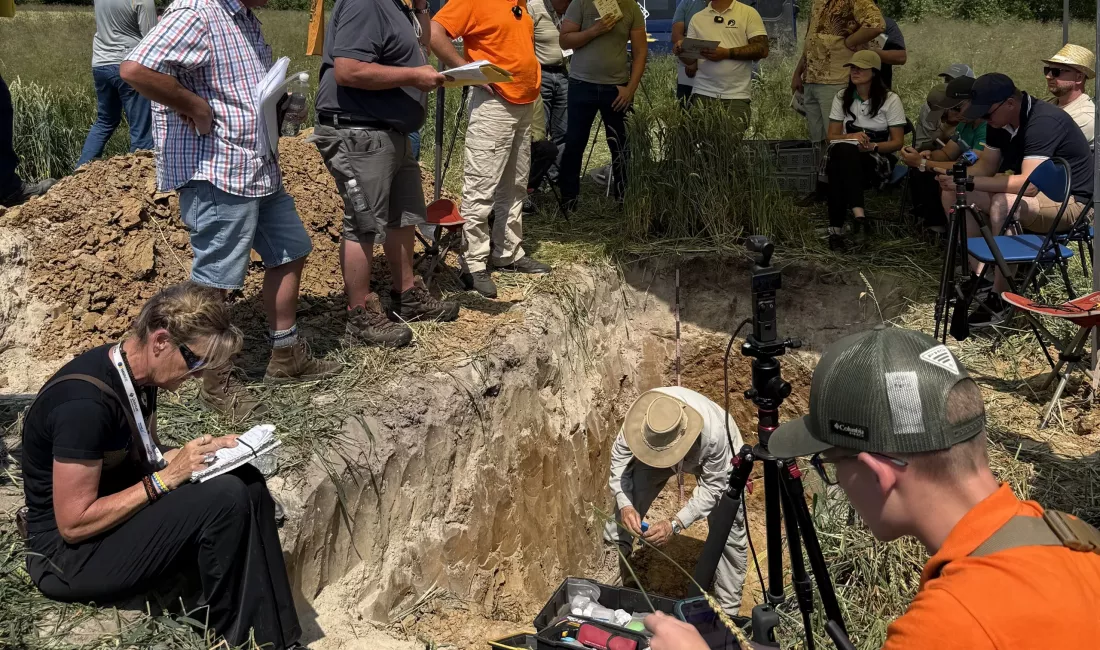
On a sunny day last July, two dozen Ukrainian farmers and soil experts from the U.S., New Zealand, Germany, and Canada huddled around a 6-foot-deep soil pit in a field of winter wheat, not far from Chernobyl. A sudden bang made everyone flinch. A sonic boom from a missile passing overhead, a farmer explained.
The soil had been depleted after decades of disuse, yet the wheat waved golden-green beneath an impossibly blue sky—the living colors of the Ukrainian flag, a symbol seen everywhere in this country at war. Here in Europe’s breadbasket, cultivating the land amid the war’s destruction has become an act of patriotism and resistance.
The experts were traveling around the country meeting with farmers, analyzing the soil and devising solutions to improve yields and help rebuild Ukraine’s economy, in conjunction with top agricultural companies. I joined as part of a small delegation from Legacies of War, a U.S.-based nonprofit advocating for sustained funding for humanitarian demining, mine risk education, and victim’s assistance.
We met farm manager Andrii, who had fled Kherson after Russian troops seized his farmland—over 2000 hectares of land, worth millions, employing more than 30 farmers in Eastern Ukraine. Russian troops occupied the city and Andrii’s farms for eight months in 2022, imprisoning Andrii himself after he evacuated his family. The area has since been liberated but faces constant shelling. It is also fully mined, scattered with dangerous weapons buried in the soil.
Now, Andrii is rebuilding from scratch in these sandy soils north of Kyiv, his son stepping in when Andrii must leave for the frontlines to pilot a Ukrainian army helicopter.
Andrii’s story is far from unique. Russian seizures, landmine contamination, and military operations have stolen an estimated 5 million hectares—nearly 20% of Ukraine’s arable land—from thousands of farmers since the start of the war. Even when the fighting stops, landmines and unexploded ordnance (UXO) will keep a great deal of Ukrainian territory locked from productive use for decades. Over 6 million people live in or around these dangerous areas, the United Nations has estimated. More than 800 have already been killed by UXO.
Please read the rest of the essay at Zócalo Public Square.