Wouldn’t it be great for people to have a tool that would help them determine which mediums of citizen participation they can access to make their voice heard?
Notably, many possibilities are available, but they are often either not very well-known, hard to learn about or deemed ineffective by the majority. One ‘’master tool’’ for all (or as many as possible) participation tools would really be beneficial for society, as it would only take one click to access all information on how they work and how you can use them.
And what better way to develop this than to use one of the most widespread tools of participation known to mankind – the Internet. It might not sound logical, but if you think about it, the Internet can be considered a participation tool in many ways, given how many people are using it to put their two cents in.
With the help of the Internet, young people today seem to be at the forefront of popularising different avenues of participation. On one side, we have some young people with a large-scale following online, which allows them to do this through their own, self-grown platforms. While others do it through the platforms of their companies, organisations or unions.
The common point is that young people are effectively using the Internet’s online algorithms for a good cause. According to a 2025 Eurostat research on youth civic and political participation, young people are far more likely to express their political beliefs online, as opposed to other generations, spreading news or making informational content on topics of world importance like international politics and global cultural movements that deserve accessible coverage, but can be hard to understand if presented inadequately. And inadequate presentation is what ends up happening in the end because of how the Internet works.
It is no secret that online spaces run on algorithms, mostly developed to benefit corporations and desensitise users. Currently, what wins over the masses is short-form video content with no real substance, often pushed by brands as part of their agenda to build capital. This type of content can (and does) easily outperform information about our rights, our democracies and the opportunities we have to influence them.
As a result, we find ourselves in a paradoxical situation where we do have access to more information than ever before, but finding resources we actually need can be surprisingly difficult.
Young people experience this the strongest, as they are usually the main targets of such algorithms. This is to be expected, because after all, according to a 2025 Eurostat report, 97% of young people use the Internet daily. Despite this, as the main users of the Internet, young people have a huge advantage in knowing how these algorithms work and are aware that they are being targeted, as proved by the University College of Dublin. I would also argue that they are the main group that’s actively fighting against them.
Still, how do you fight something when information about how to participate needs to become easier to find, understand and use?
The Democracy Camp’s Youth-Led Guide to Making Your Voice Heard
The good news is that many such ‘Master tools’’ are being developed, including in our Democracy Camp youth exchange! Participants of the Camp are yet another example of young people being active in democracy and politics.
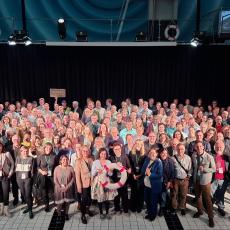
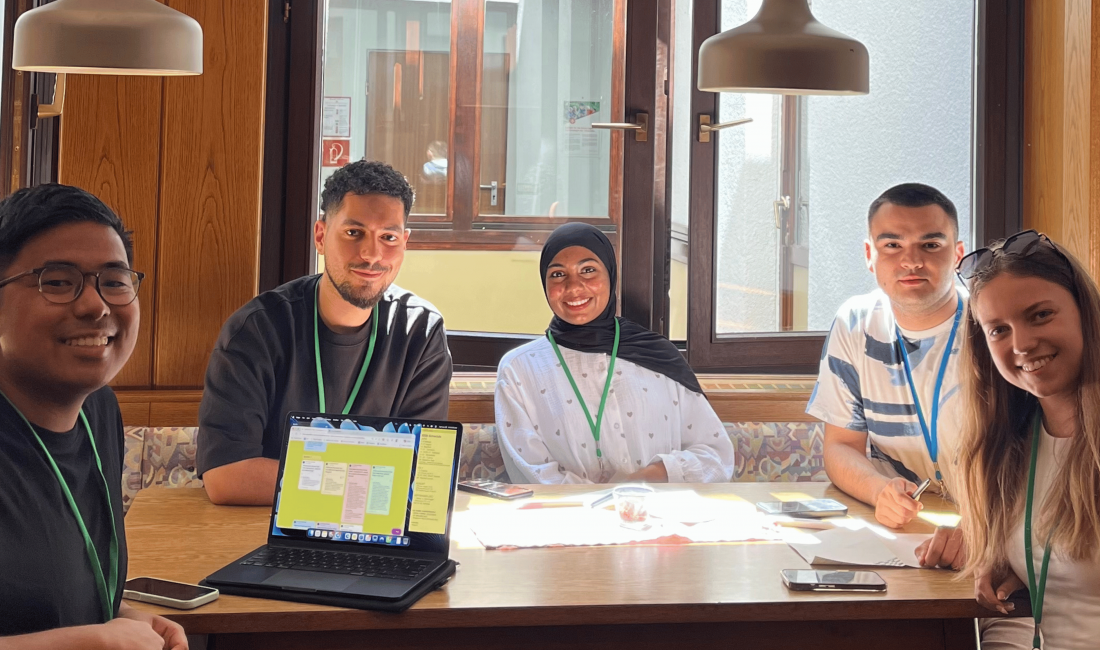
Every one of them is engaging in an in-person and online exchange of information with one another, even joining forces with participants of other editions of the Camp. All of this happens with one main goal of disseminating the knowledge they learned about different participation tools they can use around Europe.
How? Through the creation of the Youth Participation Handbook 2026 - a guide to youth participation in Europe and the world. It is entirely youth-led, by participants of the Camp and collects all essential information in a single document. The idea is that knowledge is not just gatekept in the Camp, but is spread across communities and institutions so that opportunities are not only seen but understood as well.
In many senses, this Handbook is the ‘’master tool’ that many people need to effectively exercise their rights as citizens.
Having too much information online can make it hard to differentiate between what is true, what is not and what is relevant. Still, participants of the Democracy Camp have been able to condense the information in an easily accessible way for people of all ages and countries, from the visuals to the writing and language used to describe the different opportunities.
Since the topics of the exchange cover democracy, sustainability and inclusion, the Handbook reflects on participation tools that can be used to promote change in these mediums.
Imagine What We Could Do If We Knew How
At the end, the truth is one - all the benefits of the Internet can be used in good faith to promote something mutually beneficial to us. All the resources are there. We just need to harness them and start using it to our advantage.
The Democracy Camp simply proposes one way of harnessing this power, while the participants are actively using it.
Still, for what it is, the itself Camp has only seen around 400 young people in total over the years. In reality, there are way more than 400 young people who are committed to making a change without knowing the possible reach they can have with these tools and the Youth Participation Handbook 2026.
Imagine what they would be capable of doing if they knew about them…