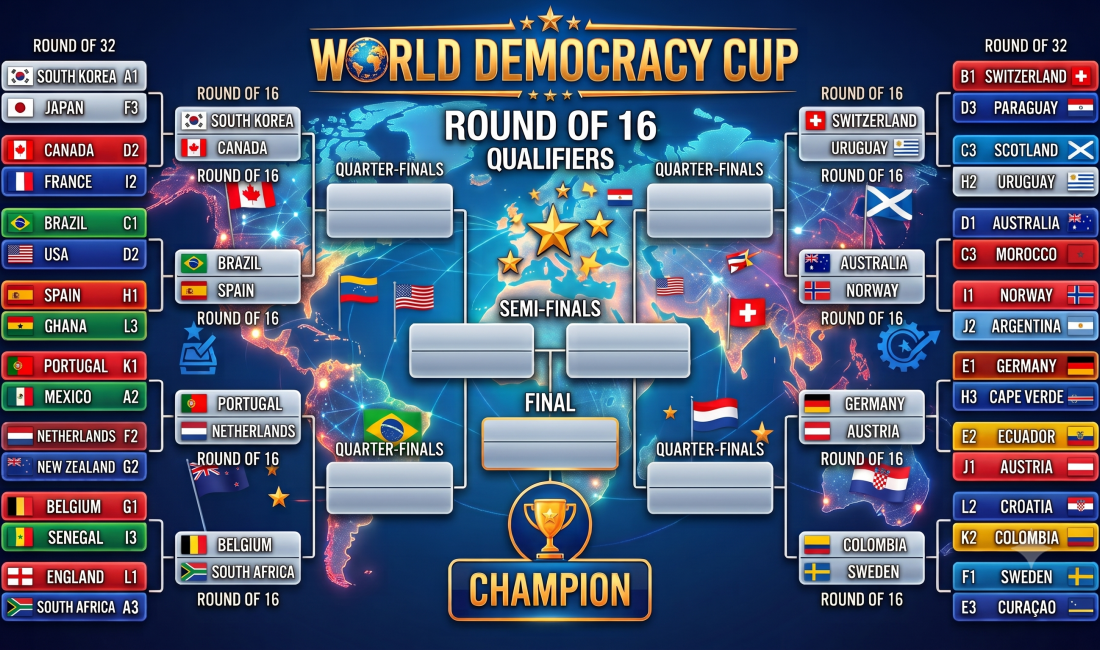
A World Cup Decided by Participation and Deliberation Reaches Knockout Rounds
What if the World Cup were decided not on football but on democracy—deliberation, participation, direct action, digital tools, and local governance? Welcome to the World Cup of Democracy, from Democracy Local. Three weeks ago, we laid out the Group Stage, from the 48 teams in the football World Cup to 32 in the playoffs. Now we offer a breakdown of the 16 matchups of this round--and the 16 winners.
South Korea vs. Japan
An East Asian derby with completely opposing styles. Japan relies heavily on traditional, quiet representative consensus and lacks active digital toolkits. South Korea has perhaps the world’s most democratic big city in Seoul, and is an established digital powerhouse running advanced e-People civic tech and institutionalized deliberative citizen juries.
Winner: South Korea
Canada vs. France
The Battle of the Assemblies. France brings highly funded municipal participatory budgeting in Paris and its recent Citizens’ Conventions. But Canada counters with deep provincial decentralization and a long history as a premier global laboratory for highly successful citizens' assemblies.
Winner: Canada’s deep structural federalism provides the edge over France's historically centralized state
Brazil vs. United States
A massive Western Hemisphere clash. The United States features powerful local and state-level direct democracy (like California's ballot initiatives), but it’s a laggard in deliberative and participatory processes. And its federal level is dragged down by growing authoritarianism intense political polarization. Brazil—the legendary birthplace of participatory budgeting—commands this match with constitutional mandates that build democratic agency from the neighborhood level up.
Winner: Brazil’s grassroots neighborhood power defeats institutional polarization.
Spain vs. Ghana
Ghana’s District Assembly system structurally promotes local governance, but deep financial dependency on the central government holds it back. Spain arrives as a digital juggernaut, leading the world with open-source civic tech platforms like Decidim and Decide Madrid.
Winner: Spain’s open-source digital sovereignty dominates the pitch.
Portugal vs. Mexico
This is one of the tightest contests of the round. Mexico punches above its weight with Mexico City's participatory leadership and profoundly democratic constitution, but it faces massive systemic hurdles and democratic retrenchment federally. Portugal is an absolute master of participatory budgeting innovation, boasting deeply institutionalized municipal versions and the European Capital of Democracy, Cascais.
Winner: Portugal, narrowly
Netherlands vs. New Zealand
Stagnant consensus vs. Dynamic transparency. The Netherlands' famous "Polder model" is struggling to find forward-looking political leadership. New Zealand counters with sky-high government transparency and innovative governance models that blend modern digital tools with traditional Māori collective deliberation.
Winner: New Zealand. The Kiwis advance with one of the world’s most cohesive democracies.
Belgium vs. Senegal
Top-tier institutional architecture vs. West African progress. Senegal has a proud history of resisting regional autocratic trends, but fiscal constraints limit true local agency. Belgium is a specialized tournament heavyweight, intensely decentralized and utilizing the Ostbelgien model—a permanent, legally recognized citizen council.
Winner: Belgium’s permanent citizen architecture is simply too strong.
England vs. South Africa
Digital pipeline vs. New Coalitions. South Africa is entering a more consensus-oriented coalition era but is still reforming its local bureaucracies. England faces threats from an anti-democratic far right, but leans on expanding deliberative citizen assemblies and a highly responsive digital petition platform that mandates parliamentary debate for popular citizen-led ideas.
Winner: South Africa in an upset, as England chokes away its advantages.
Switzerland vs. Paraguay.
The biggest mismatch of the round. Paraguay safely outpaces total autocracies but suffers under corruption and a massive lack of direct democracy tools. Switzerland, the undisputed tournament favorite, dominates effortlessly through its hyper-decentralized canton structure and frequent, binding citizen initiatives.
Winner: Switzerland
Scotland vs. Uruguay
A battle of small but very democratic heavyweights. Scotland is a European titan in deliberative democracy, regularly running national Citizens' Assemblies on major issues. Uruguay, however, is a beacon of direct democracy in Latin America, frequently using national binding referendums to let citizens directly decide socio-economic policies.
Winner: In an absolute thriller, Uruguay’s binding national voting power edges out Scotland’s advisory assemblies.
Australia vs. Morocco
Deliberative mastery vs. Centralized monarchy. Morocco has introduced avenues for citizen petitions, but power remains heavily centralized under the King. Australia arrives as a global champion of deliberative democracy, utilizing structured citizens' juries and consensus panels seamlessly at local and state levels.
Winner: Australia cruises.
Norway vs. Argentina
Flawless stability vs. Political roller-coasters. The Action: Argentina’s provincial autonomy and history of participatory budgeting are rich, and Buenos Aires is making democratic gains.Bbut its national politics are a volatile ride. Norway is unsurprisingly dominant, blending deep local government portfolios with absolute digital transparency and a deep culture of grassroots consultation.
Winner: Norway.
Germany vs. Cape Verde
Heavy federalism vs. Island decentralization. The Action: Cape Verde is a standout model for stable African governance with highly effective municipal-level decentralization. However, Germany’s robust federal system grants massive structural autonomy to the Länder, where modern direct democracy is making rapid progress.
Winner: Germany's structural scale and resources overwhelm Cape Verde.
Ecuador vs. Austria
Constitutional innovation vs. Deliberative compromise. Ecuador's constitution explicitly enshrines citizen participation through the "Fifth Power." Austria counters with robust federal architecture, a strong tradition of social partnership, and successfully piloted national-level citizens' climate assemblies.
Winner: Austria's institutional stability and deliberative compromise secure a tight victory over Ecuador's volatile political climate.
Croatia vs. Colombia
Representative baselines vs. Progressive mandates. Croatia features a stable representative framework but has yet to scale up direct or smart digital tools. Colombia leaps ahead thanks to its progressive 1991 Constitution, which explicitly mandates diverse mechanisms of citizen participation (cabildos abiertos) and local participatory budgeting. Bogota’s innovative governance provies a boost.
Winner: Colombia’s constitutional toolkit wins the midfield battle.
Sweden vs. Curaçao
Local autonomy showcase. The Action: Curaçao enjoys high regional autonomy within the Dutch Kingdom but lacks scaled tools. Sweden puts on a masterclass in local agency—its municipalities possess incredible decentralized power, including independent tax-raising authority.
Winner: Sweden wins comfortably on fiscal localism.