At One of the World's Longest-Running Local Protests
The latest in our regular feature, following the never-ending travels of democracy reporter-and-supporter Bruno Kaufmann, global democracy correspondent for Swiss Broadcasting, and founder of the Global Forum on Modern Direct Democracy and board member of Swiss Democracy Foundation.
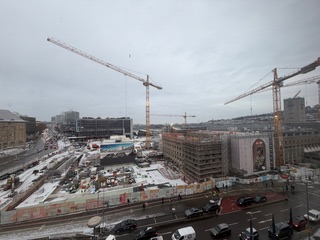
On a recent Monday, I visited a hole in the ground where a train station is supposed to be.
I was in central Stuttgart, and I was there not for the hole but to visit the longest-running protest in German history.
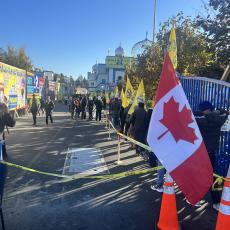
Every Monday for more than 770 weeks (which is more than 14 years), hundreds of people—there were somewhere between 300 and 400 the day I was there—have protested against this rail station.
The story of Stuttgart 21, the name for the railway project, is long but important. Stuttgart is in the German state, or land, of Baden Wurttemberg, a wealthy place, home to Porsche and Mercedes. It was also politically stable. For 60 years after the Second World War, Baden Wurttemberg was governed by the Christian Democrats.
In the 21st century, the Christian Democrats had this idea about building a new railway station in the middle of Stuttgart and underground, which would allow a big space above the underground railway to be developed as real estate.
The project was marked from the beginning by corruption, which created considerable protests and tensions. In 2010, those protests became the so-called Black Thursday, when police responding to protests hurt hundreds of people. Stuttgart was shocked to see violence against political protests.
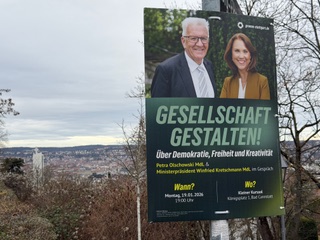
In 2011, the shock became a political earthquake, when the Christian Democrats lost power in elections. Winfried Kretschmann was elected prime minister of Baden Wurttemberg, making the first Green politician to lead a German state.
He was elected because he campaigned against the railroad station. But he didn’t cancel the project. He instead allowed people to decide whether to continue the project in a referendum. Given the billions already invested, 56 percent of the public voted to keep building the railroad station.
Kretschmann changed the government to emphasize listening to the people. He created a ministry for participation, added democratic infrastructure, and changed the way governance is done in Baden Wurttemberg. Municipalities are now provided with expert staff to run deliberative and participatory processes, paid for by the state government.
Meanwhile the railway station project has become less popular with the passage of time. One problem is that it will limit the capacity of the railway. The current, old railway station has 20 tracks, but the new underground station would only have 8 tracks. Digital train management can’t compensate for that lack of space. There is a lot of skepticism that the project will ever work, or be able to replace the old station.
The railway project has been a failure for so long that other governments have learned lessons from it. Near the project site is headquarters of the association of the more than 1000 municipalities in Baden Wuttemberg. That municipal association has worked to develop deliberative process to avoid similar mistakes.
One key learning for the cities is that deliberative procedures cannot run as stand-alones but rather need to be part of a decision-making process, in which the citizens have a proper say by binding referendum. For example, in the city of Rottweil, south of Stuttgart, a high-security prison building project was realized because deliberative and direct democracy were wisely combined.
On March 8, there will be a new state election, for a new parliament in Baden-Wurttemberg – and it looks like that the Christian Democrats, after 15 years of Green leadership, will be back as the biggest political party. So while the Kretschmann-designed policies and infrastructure may not continue under the new leadership, changes to the local culture of democracy, along with the experience of being heard, will remain in Stuttgart.
Also: the Monday protesters plan to continue their struggle against the railway station project.
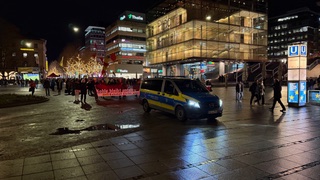
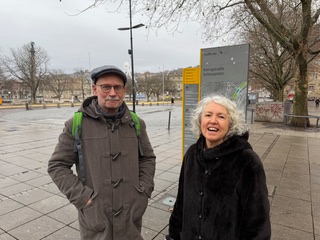
The Monday protests
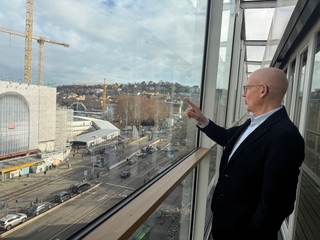
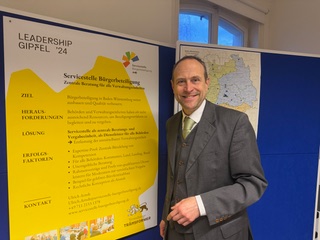
Ralf Bross, President, Association of Municipalities