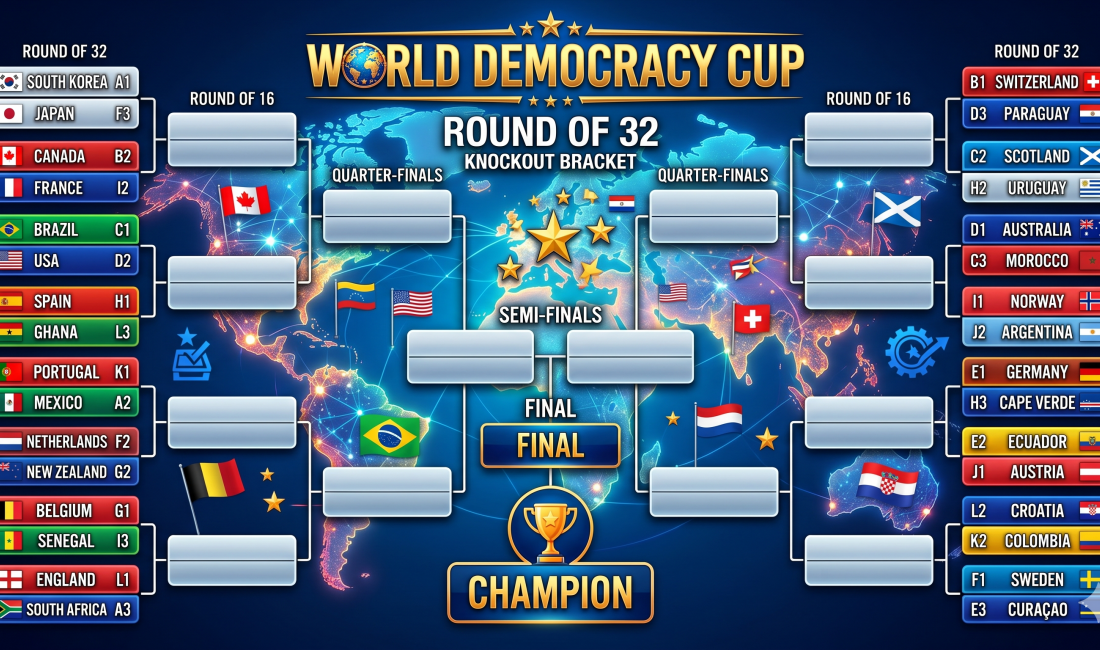
Welcome to the World Cup of Democracy. Here are the Group Stage Winners
This is being published in partnership with the Swiss Democracy Foundation, where you can suggest your own winners and engage in conversation about this project.
The 48 teams qualified for this year’s World Cup football tournament—now getting under way in Mexico, Canada and the U.S.—on very different merits from those we use in the World Cup of Democracy.
Our tournament is decided by free and fair elections, the rule of law, and comprehensive forms of participatory, direct and local democracy. Here is how such a contest would play out among 48 countries, through 12 groups and 104 matches, if democracy, not goals, determined the winners.
Group A: The Group of Democracy (Mexico, South Africa, South Korea, Czech Republic)
In the World Cup, the most competitive group is called “The Group of Death.” When measuring our way, Group A is the “Group of Democracy”
1st Place: South Korea. A modern powerhouse in smart digital democracy (via platforms like e-People) and local participatory budgeting. Their advanced integration of deliberative citizen juries—such as the national jury on nuclear energy policy—clinches them the top seed.
2nd Place: Mexico. While its federal representative institutions face systemic hurdles, Mexico punches above its weight in participatory tools. Mexico City is a world-renowned pioneer in municipal participatory budgeting. Controversial, national-level recall referendums have expanded direct democratic options.
3rd Place: South Africa. After the 2024 election the dominant ANC for the first time has entered a coalition offering a possibility to a more consensus-oriented democracy allowing for local communities to strive.
Czech Republic would advance in many groups but places fourth as its populist new leader retreats on recent democratic achievements, including strong local participation schemes.
Group B: The Federalist Group (Canada, Bosnia & Herzegovina, Qatar, Switzerland)
1st Place: Switzerland. The undisputed tournament favorite, Switzerland easily dominates through its legendary system of modern direct democracy (frequent binding citizen initiatives and referendums) and a hyper-decentralized federal structure where cantons and local communes hold massive sovereign agency.
2nd Place: Canada. Safely takes the second slot. It features deep provincial decentralization (heading towards a secession vote in Alberta) and has long been a leading laboratory for deliberative democracy, routinely deploying highly successful citizens' assemblies to tackle thorny systemic issues like electoral reform.
3rd Place: Bosnia & Herzegovina. Advances as a third-place candidate mostly by default. While technically decentralized, its governance structure is fragmented and gridlocked by ethnic quotas rather than genuinely empowering local civic participation.
Qatar finishes fourth as an absolute monarchy, despite its ambition to be a more open and modernistic outlier in the region.
Group C: The Participatory Group (Brazil, Morocco, Haiti, Scotland)
1st Place: Brazil. The legendary birthplace of participatory budgeting (originating in Porto Alegre), Brazil commands this group due to its constitutional mandates for municipal participatory councils and a deeply decentralized framework that builds democratic agency from the neighborhood level up. It also has improved its democratic credentials since the darkest days of the Bolsonaro regime.
2nd Place: Scotland. Scotland pushes Brazil hard for the top spot. It is a European leader in deliberative democracy (regularly executing national Citizens' Assemblies on climate and funding) and possesses robust devolved regional powers alongside excellent digital civic portals. Constitutional efforts to become more independent are underway.
3rd Place: Morocco. Finishes third. While its 2011 constitutional reforms encourage local governance and participatory petitions, power remains heavily centralized. Good news: Parliament has gained territory vis-à-vis the king.
Haiti, dealing with severe institutional instability and civil war, brings up the rear.
Group D: The Crisis Group (United States, Paraguay, Australia, Türkiye)
1st Place: Australia locks in first place as a global champion of deliberative democracy. Its extensive and highly structured use of citizens' juries and consensus panels at the local and state levels fulfills the tournament's criteria even though federal reform processes are stuck in a dysfunctional referendum system.
2nd Place: United States. Despite its president’s authoritarian consolidation, the U.S. advances due to extreme decentralization. American federalism gives immense agency to states and municipalities, allowing massive experiments in state-level direct democracy (ballot initiatives in states like California), localized participatory budgeting (New York City, Chicago), and deliberative assemblies (Akron, Lexington, Los Angeles).
3rd Place: Turkiye tops Paraguay by a coin flip. Turkey’s authoritarian, hyper-centralized executive presidency drags down a country with a vibrant local democracy, including European Capital of Democracy finalists Denizli and Ankara.
Paraguay suffers under the long-term and corruption-ridden leadership of the Colorado party and lacks the digital infrastructure, direct democracy tools, and local community agency seen in the top two.
Group E: The Localist Group (Germany, Curaçao, Ivory Coast, Ecuador)
1st Place: Germany cruises to the top of Group E. Its federal system grants massive structural autonomy to the Länder (decentralization), where modern direct democracy is making progress. Some efforts at deliberative democracy have reached the federal level.
2nd Place: Ecuador. Puts up a strong showing to take second. Ecuador's constitution explicitly enshrines citizen participation through the “Fifth Power” (the Council for Public Participation) and mandates local participatory budgeting, giving communities a structural voice.
3rd Place: Curaçao. Places third. As a constituent country within the Kingdom of the Netherlands, it enjoys substantial local autonomy, though the scale of digital and direct democratic tools is small.
Ivory Coast finishes fourth after its president misused his powers to prolong his tenure.
Group F: Group of Doubters (Netherlands, Japan, Sweden, Tunisia)
1st Place: Sweden. A masterful performance in local agency. Sweden’s municipalities possess incredible decentralized power, including independent tax-raising authority. The national level underperforms under the current right-wing government.
2nd Place: Netherlands. Another ‘former’ model democracy which still shines through its legendary "Polder model" of consensus and a rapid, modern expansion into deliberative citizen assemblies (burgerberaden). But as with Sweden, the Dutch parties have a hard time offering forward-looking democratic leadership.
3rd Place: Japan. Finishes third. Japan has stable local assemblies and decentralized laws, but its political culture relies heavily on traditional representative consensus rather than active direct democracy or digital participatory toolkits.
Tunisia places fourth due to a continuous backsliding from its democratic achievements after the 2011 revolution. Tragically, it’s now a harsh autocratic dictatorship.
Group G: The Ancient Glory Group (Belgium, Egypt, Iran, New Zealand)
1st Place: Belgium. A top-tier contender in this specialized tournament. Belgium is intensely decentralized along regional and linguistic lines. More importantly, it is a global pioneer in deliberative democracy—most notably the Ostbelgien model, which features a permanent, legally recognized citizen council.
2nd Place: New Zealand. Cruises into second place. It features high government transparency, robust local community agency, and innovative experiments blending modern digital tools with traditional Māori collective deliberation, co-governance models and environmental personhood solutions.
3rd Place: Egypt. Finishes third purely by default in a group with heavy authoritarian presence. Its centralized state lacks genuine participatory avenues.
Iran, its authoritarian regime under siege from within and from abroad, places fourth.
Group H: The Modernizer Group (Spain, Cape Verde, Saudi Arabia, Uruguay)
1st Place: Spain. An absolute juggernaut in smart digital democratic tools. Spain leads the world via open-source civic tech platforms like Decidim (Barcelona) and Decide Madrid, which allow citizens to directly propose legislation and control participatory budgets. This, plus deep regional autonomy, wins the group.
2nd Place: Uruguay. Pushes Spain to the limit. Uruguay is a beacon of direct democracy in Latin America, frequently using national referendums to decide major socio-economic policies. It also features robust municipal participatory budgeting in Montevideo.
3rd Place: Cape Verde. A highly impressive third. One of Africa’s most stable democracies, it has successfully decentralized significant power to municipal levels, though it lacks the advanced digital and deliberative tools of the top two.
Saudi Arabia modernizes as well but without all the necessary features of modern democracy.
Group I: The Group of Progress (France, Senegal, Iraq, Norway)
1st Place: Norway. Unsurprisingly dominant, Norway blends deep local government agency (municipalities control massive portfolios) with high digital transparency and a culture of grassroots community consultation, despite national-level struggles with its 1814 constitution.
2nd Place: France. La Grande Nation takes second thanks to a massive recent pivot toward deliberative democracy (such as the Citizens' Convention on Climate) and highly funded municipal participatory budgeting projects, most notably in Paris. The French are heading towards a very competitive 2027 presidential election.
3rd Place: Senegal. Secures third place. Senegal has a proud democratic tradition in West Africa and has actively pursued decentralization policies though local community agency. While remaining limited by national fiscal constraints, it resists autocratic trends in the region.
Iraq finishes fourth as a fragile federal state with multi-party elections.
Group J: The Roller-Coaster Group (Argentina, Algeria, Austria, Jordan)
1st Place: Austria. Takes top honors through its robust federal architecture and a strong tradition of social partnership and deliberative compromise. Austria has also successfully piloted national-level citizens' climate assemblies.
2nd Place: Argentina secures second. While national politics can be highly volatile as a roller-coaster ride, Argentina's federal structure gives provinces deep autonomy, and Buenos Aires has a rich, pioneering history of participatory budgeting, top-class election management and one of the world’s best public banks.
3rd Place: Jordan. Places third in a structurally weak group. As a constitutional monarchy with heavily centralized executive power, its participatory tools are highly limited.
Algeria finishes fourth as its military keeps the people down.
Group K: The Beginners Group (Portugal, DR Congo, Uzbekistan, Colombia)
1st Place: Portugal. An absolute master of participatory budgeting innovation and home to the current European Capital of Democracy, Cascais, Portugal has also launched a national participatory budget project alongside deeply institutionalized municipal versions.
2nd Place: Colombia. Earns second place through a highly progressive 1991 Constitution that mandates diverse mechanisms of citizen participation (cabildos abiertos) and initiated local participatory budgeting.
3rd Place: Uzbekistan. Finishes third, showing initial beginnings of local democracy efforts and media freedoms, while still being under the strong hand of its presidential administration.
The DR Congo brings up the rear due to systemic instability, despite promising beginnings after independence.
Group L: The Midfielder Group (England, Croatia, Ghana, Panama)
1st Place: England. Takes the top spot here. Despite fiscal tensions, it features an expanding layout of deliberative citizen assemblies and a highly responsive digital petition platform that mandates parliamentary debate for popular citizen-led proposals.
2nd Place: Croatia. Finishes second with a stable representative framework and decentralized local government units, though it has yet to fully scale up direct or smart digital democratic tools.
3rd Place: Ghana. Secures third place. As a democratic anchor in West Africa, its District Assembly system structurally promotes local governance, though deep financial dependency on the central government holds back true community agency.
This is the toughest decision of the first round. Panama places a very competitive fourth, given recent democratic strides and robust political competition, with more independent forces entering politics. You could make a case for putting Panama above Croatia and Ghana.
EIGHT THIRD-PLACE FINISHERS ADVANCES
To determine which eight third-place finishers secure a wildcard spot in the Round of 32, we have to look closely at the gap between stable representative nations with emerging local autonomy and those bogged down by institutional paralysis or centralized autocratic structures. In this tier of the tournament, the advancing teams are separated by their structural baseline of civil liberties and their active, constitutional efforts to push power down to the municipal level.
The powerhouses of this wildcard group are Japan and South Africa. While they lacked the flashy, cutting-edge direct democracy toolkits of their group winners, they boast institutional stability, efforts to overcome one-party regimes, and highly functional, transparent municipal bureaucracies.
Joining them are another trio of African overachievers: Cape Verde, Senegal, and Ghana. These three nations advance because they have spent the last few decades codifying decentralization into law—such as Ghana’s District Assembly system and Senegal’s "Acte III" reforms—giving local communities far more fiscal and political agency than standard developing nations.
Curaçao claims a spot due to its robust island-level self-governance, while Paraguay and Morocco squeeze through the door simply by maintaining functioning constitutional frameworks and basic local petition mechanisms that outclass the remaining competition.
- Japan (Group F) – Advanced digital infrastructure and deeply stable municipal governance.
- South Africa (Group A) – Deep democratic roots, new forms of coalition building and institutionalized local administrative freedom.
- Cape Verde (Group H) – A standout model for African governance with highly effective municipal-level decentralization.
- Senegal (Group I) – Strong regional civic engagement and active, legally enshrined decentralization frameworks.
- Ghana (Group L) – A robust District Assembly system that structurally brings governance directly to local communities.
- Curaçao (Group E) – High regional autonomy and independent legislative self-governance within the Dutch Kingdom.
- Paraguay (Group D) – A standard, stable constitutional republic that safely outpaces more restrictive regimes.
- Morocco (Group C) – Grabs the final spot thanks to recent constitutional avenues allowing citizen petitions and local development councils.
4 THIRD-PLACE TEAMS HEAD HOME
Bosnia & Herzegovina (Group B) – Eliminated due to severe administrative fragmentation and ethnic veto gridlocks that paralyze citizen agency.
Jordan (Group J) – Left behind due to heavily centralized executive and monarchical power that leaves little room for grassroots tools.
Uzbekistan (Group K) – Despite minor modern digital feedback upgrades, it remains too hyper-centralized to compete.
Egypt (Group G) – Finishes at the bottom of the wildcard tier due to a highly centralized state apparatus with minimal genuine participatory avenues.