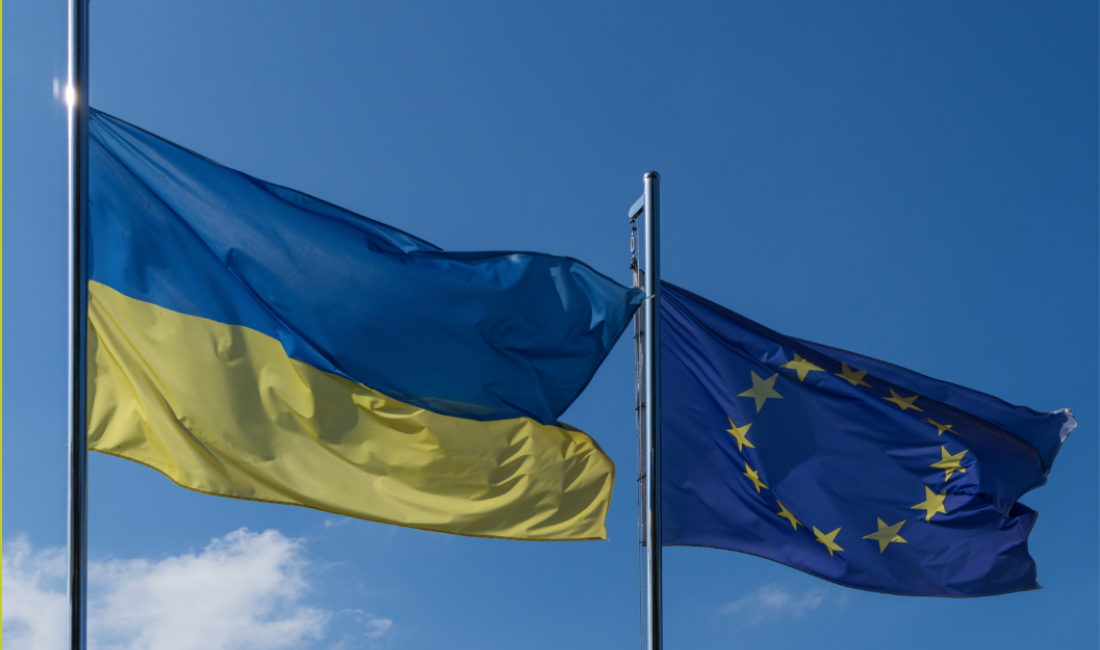
In June 2022, something extraordinary happened. Ukraine, a country under invasion, was granted candidate status to join the European Union. For many Ukrainians, this felt like a promise: fight for your country now, and a European future awaits. Support for joining the EU soared past 80 per cent.
Three years on, that enthusiasm is fraying at the edges. Recent polling shows that support for strict EU reform demands has dropped from 70.4 per cent to 62.8 per cent between 2023 and 2025. A small but growing group of Ukrainians, now 9.5 per cent, say the EU has “no right to teach us” and that Ukraine should “handle its own affairs”. The war has not stopped. The reforms keep piling up. And the finish line keeps moving.
This raises an uncomfortable question: can a country still believe in a process that never seems to end? We set out to explore exactly that. Our focus was on a specific idea: could giving ordinary people more of a voice, through round tables, citizens’ assemblies and public consultations, help repair the cracks?
Trust needs more than voting and results
Political scientists usually talk about two ingredients that keep people believing in their government. The first is having a say, for example through elections. The second is getting results, or rather, seeing that the system actually delivers. Ukraine’s accession process is missing both. Ukrainians cannot vote on the conditions the EU sets. And the reforms demanded of them take years to show any visible pay-off.
That leaves a third, less obvious ingredient: the quality of the process itself. Political scientist Vivien Schmidt calls this “throughput”, and it sits right between having a say and getting results. It asks whether decision-making is done well: is it effective, is someone accountable for it, is it open to public scrutiny, does it include a wide range of voices, and does it genuinely listen to civil society? We used these five yardsticks to examine Ukraine’s accession process, and combined this with a second question: does Ukraine’s wartime sacrifice weigh on people’s sense of fairness towards the EU?
Where dialogue works, and where it stops working
The research found something of a paradox. Where Ukraine has built structures for dialogue, such as reform working groups involving civil society organisations, they can genuinely shape decisions. One expert interviewed for the study described how, on the flagship rule-of-law roadmap, the key reforms civil society had pushed for, such as overhauling the prosecutor general’s office and the police, were in fact taken on board.
But this only works for a narrow circle. Civil society groups based mostly in Kyiv have a seat at the table. Ordinary citizens, especially those outside the capital, do not. One interviewee put it starkly: there is no institution that collects citizens’ views and no official, in Ukraine or in the EU, who responds to them directly.
Even where citizens do take part, for example by submitting petitions through Ukraine’s digital government platform, the results often disappear into a void. A “rejected” button might appear on a petition, but without any explanation (even though one is required by law). As one participant in a focus group for the study said, they simply want a response, “even if it is some formal thing in the form of an email.” Exactly that - accountability - meaning some way of tracing what happened to your input, came out as the weakest link across the board. This matters because, as the research notes, once people feel unheard, they start to see their own government as something separate from themselves.
A promising fix already exists on paper. Ukraine's parliament passed a law in 2023 requiring public consultations on new legislation, but its entry into force has been postponed until a year after martial law ends. One expert called this delay a missed opportunity, precisely when trust-building matters most.
The deeper wound dialogue cannot heal
Here the thesis reaches its most striking conclusion. Even where consultation genuinely works, it cannot fix everything. Underneath the frustration with slow bureaucracy lies a deeper feeling: that Ukraine has already paid its dues, in blood, and that Europe has not properly acknowledged this.
One respondent described it plainly: Ukraine is not approaching the EU as a supplicant, “nearly begging”, but as “a full-fledged partner” that has helped protect European security. Tellingly, even the EU-side expert interviewed agreed the sacrifice was real, “entirely true”, while insisting that military effort cannot simply buy leniency on rules around courts or trade. Both views are sincerely held, and both cannot be true. That gap, between what Ukrainians feel they are owed and what Brussels is prepared to formally recognise, is not something a better consultation process can paper over. It sits above and beyond the question of good governance altogether.
What this means for people working on participation
None of this means dialogue is pointless. Quite the opposite: the research shows that where it is built into real decisions and not just symbolic, it genuinely builds trust. But two lessons stand out for anyone working on citizen participation in similar contexts, whether in EU accession or elsewhere.
First, a good consultation process needs a feedback loop. People do not need every request granted, but they do need to know what happened to what they said, and why. Publishing a simple, public record of what input was accepted, adjusted or turned down, and the reasoning behind it, would go a long way.
Second, participation should not remain a capital-city affair. Bringing deliberation closer to people outside the main cities is not just fairer; it is also how ordinary citizens, not only professional civil society organisations, come to feel that the process belongs to them too.
What the research makes clear, above all, is a distinction worth holding onto: good process and fair recognition are two different things, and a country can be doing everything right on one front while still feeling badly let down on the other. For Ukraine, and for anyone designing participation in high-stakes, unequal negotiations, that distinction may be the most important lesson of all.