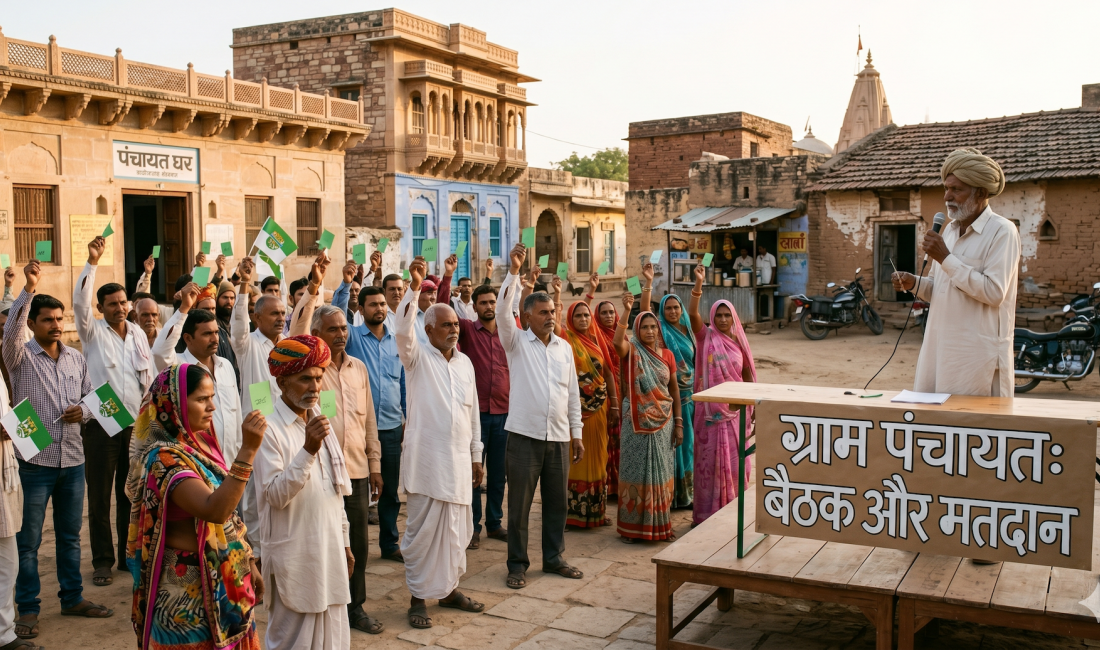
The annual report digs deep on local democracy, and finds growth.
Republished from Democracy International.
The Global State of Direct Democracy Report by Clara Egger and Raul Magni Berton gathers legal provisions, held referendums, short-term trends in the use of direct democracy institutions, reforms and academic publications. The Report provides comments to create a comprehensive picture of the current state of direct democracy.
The contrast with the previous edition is striking. In the Global State of Direct Democracy 2024, we acknowledged that 2023 had been a lean year for popular votes. 2024 answered that question emphatically. Ireland, Uruguay, Vanuatu, Niue, Switzerland, Lithuania, and Liechtenstein all held consequential national votes. In the United States, a post-Dobbs wave of citizen-initiated amendments swept through ten states. Moldova, Ecuador, Kazakhstan, Qatar, and Slovenia added further episodes of varying democratic quality. By any measure, 2024 was one of the most active years for popular voting in recent memory — not only in volume, but in substance: constitutional safeguards against self-entrenchment worked in the Pacific, Swiss voters drew clear lines on pension and environmental policy, and Moldovan voters enshrined a European future by the narrowest of margins. 2025 was more sobering: backsliding accelerated in the United States, post-coup referendums in Gabon and Guinea entrenched military rule, and Haiti’s long-planned constitutional vote was cancelled entirely as state collapse made any genuine popular consultation impossible.
What this report contains.
The report is organised into five parts: the conceptual and institutional foundations of direct democracy; a global mapping of direct democratic institutions at local level with particular attention to most dynamic places; a detailed account of every significant national vote in 2024 and 2025; a review of the latest scientific evidence published in English on direct democracy; and a forward-looking section identifying key developments to watch in 2026 — from Thailand’s constitutional process to a possible mandatory referendum in France and ongoing local reforms in Germany.
The focus: local direct democracy
After a first general issue, each report adopts a thematic focus. This one turns the lens on local direct democracy — paradoxically both the most familiar and the least systematically studied arena. We concentrate on three countries where local direct democracy is deeply institutionalised and well documented: Germany, Switzerland, and the United States. Interviews bring scholarly and practitioner insight to this comparative picture.
A call to promote direct democracy
We write at a moment of unusual democratic anxiety. Direct democracy, when genuinely placing power in the hands of the many rather than the few, is a cure for backsliding. However, it can be threatened. The institutions that exist today were built slowly, over decades. Democracy — representative and direct alike — does not survive neglect. In a time when it is challenged everywhere, those who value it must be prepared to say so plainly, and to work to preserve, strengthen, and disseminate what has been built.
1. LOCAL DIRECT DEMOCRACY:
The Global State of Direct Democracy Report provides a global, comparative overview of direct democracy by analysing the legal design of its institutions and reviewing recent practice and academic debate. This second edition focuses on local-level institutions, with particular attention to three well-documented and highly developed cases: Germany, Switzerland, and the United States. By 'local', we mean 'sub-national', including regions and smaller territories. In many parts of the world, local direct democracy institutions exist in large numbers, but its scope
is modest and its use infrequent.
While national-level direct democracy has been widely compared, local-level comparison remains underdocumented. Only two comparative books (in English language) exist: Theo Schiller’s 2011 edited volume1 , limited to Europe, and Christophe Prémat’s 20222 collection of case studies. Neither achieves the systematic coverage possible at the national level, largely because local direct democracy varies more widely and depends heavily on each state’s territorial organization.
Exhaustively covering local direct democracy in even a single country is difficult; doing so globally is beyond the reach of current scholarship. Such a database will likely emerge gradually through the accumulation of national studies. For now, we offer a global but suggestive map centred on the three most effective and best-documented models. The report retains the conceptualization used in the first edition: direct democracy as a set of institutions granting citizens initiative and veto rights. The hierarchy between direct and representative institutions remains central, with particular attention to obligatory referendums and constitutional citizen initiatives.
Beyond the local-level analysis, the report also reviews developments from 2024, including notable local trends, major national referendums, and key debates and evidence on direct democracy. This introductory chapter outlines the landscape of local direct democracy, contrasts existing data sources, clarifies the institutional scope covered in the report, and presents a glossary of key terms.