A Venice Commission Brief Says Democracy Is Created by Rights, But Is Not One
In late 2024, the Republic of Guatemala asked the Inter-American Court of Human Rights to answer a straightforward question: under international law, should democracy be formally enshrined as a human right?
In an amicus curiae brief, the Council of Europe’s Venice Commission, a leading body for studying democracy, said the answer is no.
The brief is worth reading. The Venice Commission argued that while democracy and human rights are mutually reinforcing, elevating democracy to a singular, justiciable human right would be a mistake. Instead, the commission said, courts and states should protect democratic systems by fiercely safeguarding the concrete individual rights that make democratic self-governance possible.
The Venice Commission’s rejection of a standalone “right to democracy” is rooted in the practical mechanics of international law. For a legal right to be actionable—or “justiciable” before a court, in the language of the brief—its content must be clear, precise, and distinct.
Democracy, however, not so simple. Because it is a entire system of government. And that system can encompass many things: popular sovereignty, the rule of law, the separation of powers, local self-government, and, yes, human rights themselves.
Litigating an abstract interference with “democracy” would leave courts with a concept too vague for effective judicial enforcement, the commission wrote.
On top of that lies a paradox that weighs against making democracy a human right. Under international treaties, most human rights can be lawfully restricted or temporarily suspended during severe public emergencies. Democracy, by contrast, cannot be derogated or restricted, as doing so would contradict its very nature as a foundational value.
Rather than inventing a new right, the Venice Commission advocated for maintaining democracy and human rights as separate but fundamentally intertwined concepts. The Commission positted that democracy is the political environment required for human rights to flourish.
So how to defend democracy? Not as a vague collective right. Instead, the commission wrote, legal systems must defend it through its constituent parts. When a court protects a citizen’s right to free elections, a political party’s right to register, or a journalist’s freedom to report the truth, it is directly defending the architecture of the democratic system itself. Therefore, the defense of democracy relies on the rigorous judicial protection of established rights, such as freedom of association and equal suffrage.
These points are well-argued. The Venice Commission brief is less convincing when it turns to elections. The commission makes the common mistake of seeing elections as of a piece with democracy—rather than its oligarchic antithesis. The brief goes on a poorly released tangent connecting democracy to the operational and political independence of its electoral bodies. Many free and fair elections are run without electoral bodies, partisan or not. The brief is also on shaky ground when it argues for restrictive regulation on information to protect elections, while ignoring how tyrants often restrict information to win elections.
The Venice Commission vision is also blinkered on democracy protection. The commission sees this as a nation or state duty: protect elections, protect against misinformation, protect parties. But since nation-states are often the biggest threat to democracy (70 percent of humanity does not live in a democratic nation-state), what’s really needed are people-selected bodies, from the local to planetary levels, to protect democracy. Planetary governance, structured democratically, would seem to be an important element of protecting and enforcing the rights that make democracy possible.
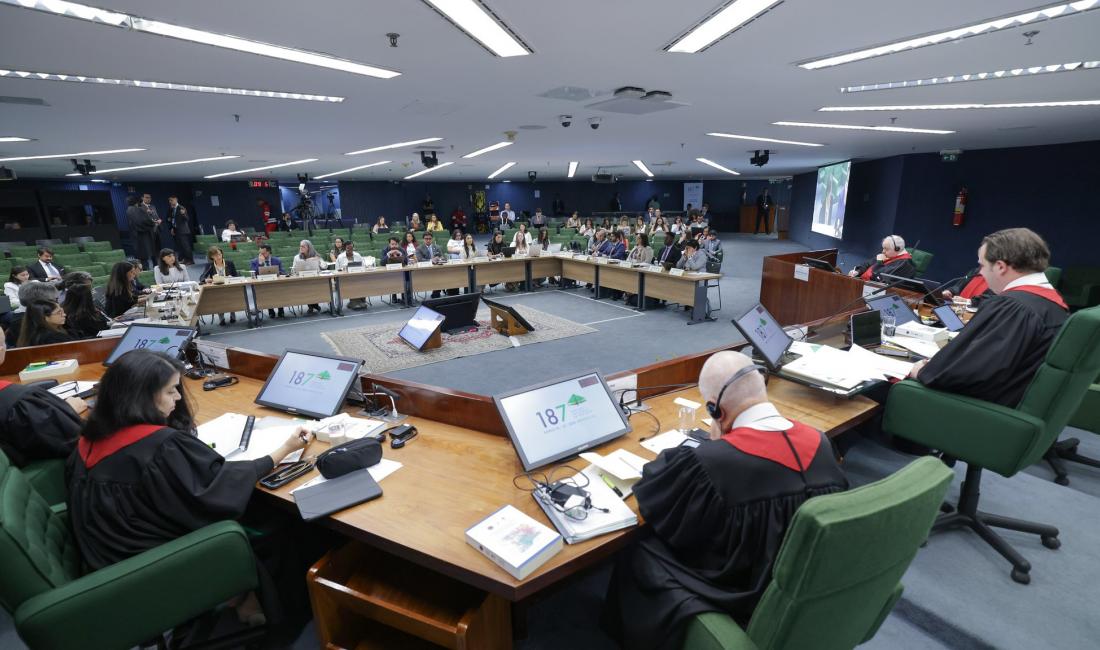
The Inter-American court held hearings in March on Guatemala’s petition. No timing for the ruling has been announced.