Date: 1/14/26
To: Charter Reform Commission
From: Charter Reform Commission Staff
Subject: City Council Expansion
Introduction
The Charter Reform Commission (Commission) and the Government Structure Committee (Committee) are considering charter reform proposals related to council expansion. At the November 19th Government Structure Committee meeting, the Committee voted to advance reforms related to single member council expansion of 23, 25 and 31 members, 9 multi member districts, and 20 single member districts with five regional seats.
On January 7th, the full Commission voted in favor of council expansion and directed staff to continue research on potential scenarios for council expansion.
Background In October of 2022 a motion (CF 22-1196) was introduced to consider a charter amendment relating to expanding the council based on population size. The Legislative Analysts Office produced reports relating to council expansion in response to the Ad Hoc Committee’s requests. The CLA reports provided analysis on expanding the council to a range between 21 and 31 members
CLA Council Expansion Reports
In these reports, the CLA analyzed operational and incidental costs associated with increasing the number of council officesCouncilmember salary is designated within the charter however the budget for each council office is set annually by the Mayor and City Council. The report highlighted two ways that council budgets could be allocated with the change. The first being that the funding per council office stays the same and the overall council office budget would increase based on the size of the expanded council.
The second being that the overall total council office budget stays the same and is divided proportionally based on the total number of. councilmembers. A chart detailing this scenario from the September 15th report is included below. Additionally the CLA report highlighted preliminary departmental impacts related to council expansion.
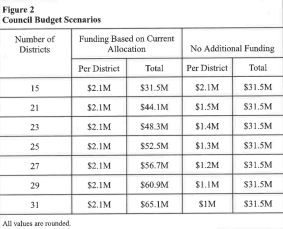
The CLA’s office conducted limited surveying of city departments on the impacts of council expansion and found that expansion would lead to an increase in requests from council offices for services, motions introduced and report back requests, and reduce efficiencies for projects since projects would become spread across multiple council districts
This would impact public works services which would not be able to automatically adjust services proportionally to the number of council districts such as the amount of street repaving per district annually. This could raise equity considerations as there becomes less flexibility with distributing these services across the district. The reports highlighted potential legislative impacts of council expansion including higher thresholds to pass legislation, quorum, and mayoral veto
More council members means more votes to wrangle for more actions.
The CLA’s report also conducted an analysis of the mechanism for expanding the Council either via fixed population growth or a specific number. For Council expansion via fixed population growth, the number of City Council districts would be tied to a specific population variable, allowing flexibility of council size. However, the report noted that there would be significant challenges to council expansion via this method in the event of large population fluctuations.
Alternatively, council expansion could be done by recommending a specific number. Past efforts to expand the council have used this approach. The Ad Hoc Governance Reform Committee indicated a preference towards council expansion via a specific number.
Council Expansion via fixed population growth
There are very few cities that have charter provisions dictating Council expansion via fixed population growth. The City of Houston had a charter provision that required the creation of an additional two council districts should the City Council determine the population of the City is 2.1 million or more. Houston reached this threshold in 2010 and the City Council was expanded in 2011
Despite census counts, there was contention in determining when exactly the City had reached the population threshold and residences which lied on City boundaries
Ultimately it was concluded the City had reached 2.1 million residents and Houston expanded their City Council from 14 to 16 members.
Single Member District Council Expansion
The Government Structure Committee voted to consider proposals of single member expansion of 23, 25 and 31 members. At the January 7th Commission meeting, the Commission passed a motion to include council expansion on the final report that will be transmitted to City Council. The commission directed staff to continue analysis of single member district models.
The Government Structure Staff Report 2 includes analysis on demographic groups that could potentially be grouped together based on certain council district sizes. This preliminary analysis was done using https://davesredistricting.org to demonstrate the relative size of council districts. Additional research from presenters provided further analysis on potential demographic makeups relative to different council sizes and potential mapping examples.
For example, OUR LA has supported council expansion between 23 and 31 stating that it would allow for plurality districts for Black and Asian Angelenos and three additional seats with a Latino majority. Additionally Cal RCV presented maps for multi member districts. A professional demographer would be required to present maps with a more definitive representation of districts.
Multi Member District Council Expansion
One proposal for council expansion is multi member council districts. This model has not been previously used in Los Angeles and is largely untested in California. The City of Portland Oregon recently adopted multi member districts. Starting in 2024, Portland voters used proportional rank choice voting to elect three members in four geographic districts. A more commonly used structure is a mixture of single members and at large or regional council representatives. In California the City of Oakland has seven single member districts and one at-large councilmember who is elected by the entire city. Other major cities including Houston, Philadelphia, and Jacksonville have a mixture of single member and at-large or “regional” seats
.
The California Voting Rights Act has struck down at-large districts if it would impair the ability of a protected class to elect candidates of its choice or otherwise influence the outcome of an election.
Council expansion via multi member districts would require consideration regarding compliance with the California Voting Rights Act. While there is
no precedent legal issue, multi member districts are largely untested in California and it is unknown if there would be legal challenges if adopted.
Operational Impacts of Council Expansion
Per analysis done by the CLA, council expansion may cause logistical challenges with passing items due to a higher voting threshold. The CLA report recommended considering voting thresholds to maintain balance of authority and to address logistical issues that may arise due to expansion. The following charter sections within Article II of the Charter lay out council actions which require two-thirds or three-fourths of the council. Expanding the council could impact the function of these actions.
Section 242. Conduct of Business
Charter Section 242(b) specifies that each councilmember will be assigned to at least one committee. Expansion would result in changes to the makeup and structure of committees. The number of committees is designated by ordinance.
Section 250. Procedure for Adoption of Ordinances
(a) Introduction and Passage requires that ordinances shall not be passed on the day it is introduced unless approved by unanimous vote of all Council members present, provided that there is not less than three, fourths of all members present.
Section 244. Quorum and Vote Necessary to Take Action
States two-thirds of the members of the Council shall constitute a quorum for the transaction of business.
Section 245. City Council Veto of Board Actions
Council may act with a two thirds vote to review the actions of any board or commission not exempt via section (d).
(a) Action by Council states that Council may veto an action with a two thirds vote within 21 days of voting
Section 250. Procedure for Adoption of Ordinances
(a) Introduction and Passage states that no ordinance shall be passed finally on the day it is introduced unless approved by a unanimous vote of at least three fourths of members present.
(c) Override by Council “The City Clerk shall present the ordinance, with the objections of the Mayor, at the first Council meeting after the Clerk has received the Mayor’s objections. The Council may pass any ordinance over the veto of the Mayor within 45 days after the objections of the Mayor are presented to the Council, by two-thirds vote of the Council or by three-fourths vote where. two-thirds vote or more was required for passage of the original ordinance.”
Section 253. Urgency Ordinance
Council may pass an urgency ordinance that takes effect immediately upon publication. nThis must be passed by a three fourths vote of the council.
Section 254. Legislation Pending Before State and Federal Government The council may establish an official position of the city in regards to legislation proposed or pending before the state or federal government. This is subject to veto by the Mayor but the Council can override the veto with a two thirds vote.