Why Deliberative Processes Must Get Dirty
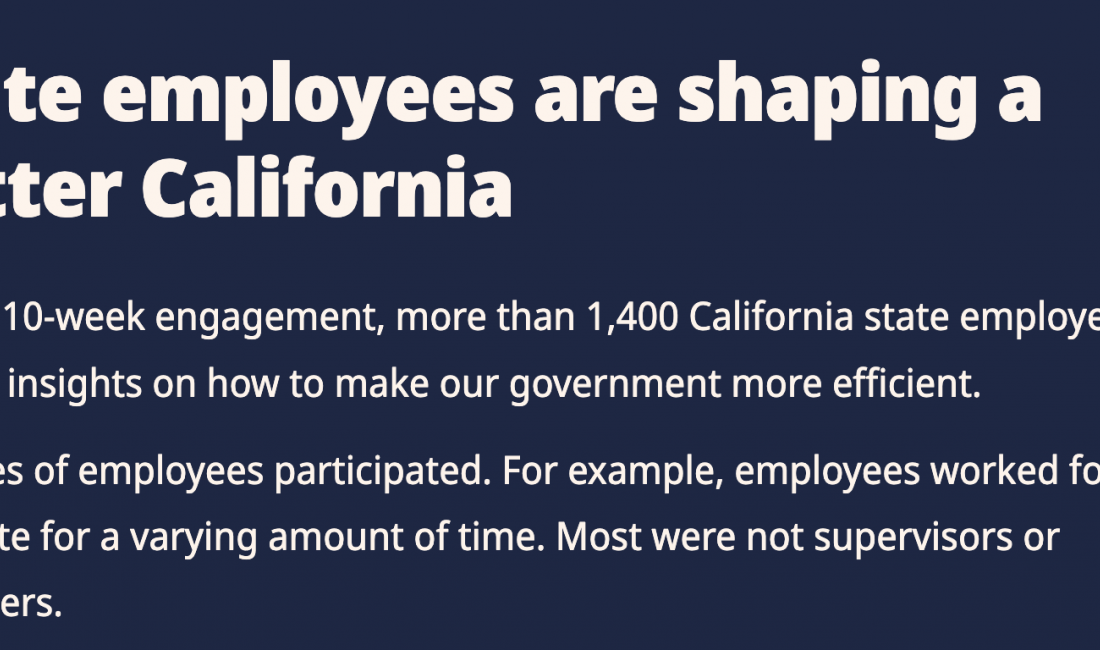
This column is co-published with Zócalo Public Square. Image-graphic via Engaged California.
Deliberative democracy is now officially entangled in state bureaucracy.
And that’s very good news.
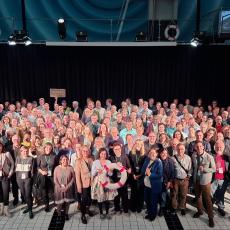
Last year, all 247,000 of California’s state government workers gained access to a new digital democracy tool called Engaged California. Those who jumped online used it to propose and deliberate on more than 2,600 ideas, most of them ways to make California’s large and complicated government smarter and faster, according to a new report.
State workers suggested eliminating unnecessary rules, forms, and slow handoffs that caused delays. They asked for less paper and better digital tools and records. They called for the state to listen more to California residents, and to improve research capacity to design better services (by, for instance, establishing internal think tanks).
The state is already acting on some of the worker recommendations, including improving data sharing between agencies and speeding up the state’s famously slow hiring process, which often causes top candidates to take other jobs rather than wait months to start work.
By jumping into questions of bureaucracy and efficiency, this project constitutes an important advance for a promising but underperforming democratic movement.
Deliberative democracy refers to processes in which juries or assemblies of everyday people, often chosen with the assistance of a lottery, deliberate on public questions and make policy recommendations to public institutions.
One type of process, the citizens assembly, has become so popular worldwide (especially in Europe and Japan) that practitioners and scholars of the field speak of a “deliberative wave.” This wave, they argue, benefits both people and policymakers.
Deliberative processes provide citizens with an alternative to leaving decisions up to politicians and government officials. And they offer leaders an alternative to making hard decisions themselves.
But viewed up close, citizens assemblies are underwhelming.
Bringing regular people together to deliberate is usally a feel-good exercise, like an island of light in a world where democracy is going dark. That’s nice, but it’s also the problem. Deliberative processes are often so pure they feel virginal—too far removed from the carnal congress of real-world governance.]
Alas, this chastity is by design. Practitioners and scholars of deliberative processes can be a prissy, perfectionist lot. (Full disclosure: I’m one of them, having witnessed major deliberative processes on four continents and advising projects, including Engaged California, as a Berggruen Institute fellow and a member of the field’s global network, Democracy R&D.)
Our default is to design deliberations as if they were lab experiments. We make them highly controlled, with the public and interested parties unable to directly engage citizen participants, whose names are not disclosed. And we keep them separate from nasty politics, powerful and aggressive lobbyists, and stifling regulators.
In a similar vein, the topics assemblies tackle are often chosen by governments or the conveners themselves, and steer clear of the most pressing problems facing 21st century technocratic governance. Deliberative bodies tend to debate narrow local controversies about land use, the making of aspirational local or regional plans for climate change, and social issues.
I looked in vain through a worldwide list of assemblies for a deliberative assembly that focused on how government really works, in a fundamental way—debating methods of regulation, or the reorganization of bureaucracies.
This isn’t surprising. We who plan and convene deliberative bodies want the work to get public attention—and land-use controversies or polarizing social issues captivate everyday folks. And practitioners, along with the governments and foundations that sponsor our work, also tend to think of bureaucratic organization as a highly technical matter, best left to technocrats.
The problem is that the technocracy, regulatory bureaucracies, and lobbyist offices are where most important government decisions actually get made. Citizens assemblies can consume many months only to produce recommendations that get ignored because they are disconnected from political and bureaucratic realities.
Indeed, there are signs of a backlash. Political scientist David Farrell, who advised successful citizens assemblies that led to the legalization of same-sex marriage and abortion in Ireland, has warned that the bodies risk losing effectiveness and political momentum.
In a provocative recent paper in the journal Politics, two scholars sympathetic to deliberative democracy—University of Edinburgh political and international relations scholar Oliver Escobar and Barcelona Autonomous University theorist Adrian Bua—sound the alarm that the field has lost touch with reality. They argue that deliberative practitioners and scholars too often devote themselves to citizens assemblies and other “mini-publics” in ways that exclude other promising forms of democratic practice, including participatory or digital processes that draw in more people.
Escobar and Bua refer to this phenomenon as “deliberative hegemony” and suggest that such obtuseness in democratic innovation can’t be defended “amid rising socio-economic inequalities and global democratic recession, including growing dissatisfaction with democracy and governance incapacity as well as the rise of authoritarian populism.”
Escobar and Bua aren’t just naysayers. They offer a solution: Embedding deliberative processes and other democratic innovations in the darkest, dirtiest corners of government. Make deliberative processes real political actors with the capacity for implementation and impact. Stop making citizens assemblies temporary bodies that disband when they feed their recommendations into authorities, and instead keep them alive for follow-up and implementation.
“Questions of change-making capacity require opening the black-boxes of public administration and the state,” write Escobar and Bua. “For democratic innovation to offer antidotes, change-making capacity must be foregrounded.”
Escobar and Bua have put a finger on a larger problem in human governance: the vast chasm between policy and reality. Policy changes get attention—but then don’t get fully implemented, and don’t produce real-world results. And frustration grows.
Governments have kept the forces of democracy—elected officials, engaged people, and democratic processes—far away from the implementers—regulators and bureaucrats inside our institutions. Reviving democracy requires more than just closing that distance. It requires a fusion of the policy with the implementation, and the democracy with the technocracy.
Which is why it’s so encouraging that California is moving its democracy into its bureaucracy.