Are Tax Credits, or Creativity, Best for Saving a City?
The characters and events depicted in this movie are fictitious. Any similarity to actual persons, living or dead, or to actual events is purely coincidental. (This is co-published with Zócalo Public Square). Image by Joe Mathews using Canva
WHO GETS THE CREDIT?
A Feature Film
Genre: Dark, Romantic Comedy
Logline: When a desperate California Film Commission bureaucrat tries to save her husband’s doomed superhero movie by securing state production tax credits, she falls for the rebellious digital artist squatting inside an abandoned soundstage—unaware that a media mogul wants the movie to fail in order to justify moving his studios to a tax haven.
Character Breakdown
MARGOT (30s): A hyper-organized, chronically stressed screenwriter-turned-executive at the California Film Commission. She uses tax credits to try to save a dying entertainment industry.
CHASE (40s): Margot’s husband. A fading, arrogant cinematographer clinging to the old Hollywood, demanding 35mm film while the world moves on.
LEO (30s): A charismatic avant-garde artist building immersive virtual worlds. Working out of an abandoned warehouse, he is aggressively independent and allergic to government subsidies.
MAXIMILIAN “MAX” VANE (40s): A sleek trust fund billionaire who recently bought three legacy studios. He secretly hates cinema. His true plan is to grab state (and Trump’s new federal) production tax credits, make a dud, write off the losses, and move his media and crypto empire to a tax shelter in Monaco.
GOVERNOR “HAIRDO” HARDING (early 60s, looks 45): California’s image-obsessed governor. He has a perfect blowout and a desperate political need to stop his Hollywood donors from fleeing the state.
Act I: The Setup
The California Film Commission is a graveyard of dreams, with a failing strategy of saving in-state movie production with tax credits that benefit wealthy producers and investors. MARGOT sits at her desk, handling tax credit requests from productions that don’t need to be in California —a Florida detective series with a monkey and a Chinese government-funded epic set in the Warring States period (in which Beijing, ahistorically, wins—to please Xi Jinping). Margot’s home life is equally bleak. Her husband, CHASE, is the director of photography on Captain Chloroform, a film, soon to start shooting, about a superhero whose power is making villains drowsy.
Enter MAX VANE, the superyacht-owning playboy boss who just acquired a studio invested in Captain Chloroform. Max delivers an ultimatum: Unless Margot and the commission deliver a massive, state-approved, tax-credit-eligible soundstage in Los Angeles, he is shutting down production, firing Chase, and moving his entire corporate apparatus to Monaco, or maybe Memphis. Max wins no matter what. He either doesn’t make the movie, saving $150 million, or he gets free money with state and federal tax credits, makes a bomb, and uses to justify moving his studio out of state.
Margot can’t justify the credits under the commission’s calculations of jobs and economic impact. But, desperate to save Chase’s job, Margot finds a loophole: an abandoned studio warehouse in a designated empowerment zone, which would make the production eligible for wage credits. She drives out to inspect it, expecting an empty shell. Instead, she discovers LEO and his collective of rogue artists, who are using cutting-edge LED volumes and game engines to build stunning, participatory visual art in which the audience directs the narrative. Margot explains that they are trespassing and must vacate so a real movie can save her marriage.
Act II: The Confrontation
Margot tries to bribe Leo to leave with state grants and relocation credits. Leo laughs in her face, rejecting the entire government-subsidized Hollywood ecosystem. “You’ve been handing out those credits for a decade,” he tells her, “and Hollywood is dying anyway.”
Forced to negotiate, Margot spends her days at the warehouse. The contrast is devastating. At home, Chase whines about the cost of vintage lenses and having to grovel to Max Vane. At the warehouse, the unsubsidized Leo and his team are vibrant, collaborative, and free. A crackling romantic tension builds as Leo shows Margot that storytelling no longer needs Hollywood gatekeepers.
Max Vane escalates his plan. He intentionally inflates Captain Chloroform‘s budget, demanding Margot deliver the credits and the warehouse immediately or he will publicly announce the relocation of all three studios. Chase turns on Margot in a toxic tirade, blaming her for his failing career. Broken and panicked, Margot bribes two L.A. city councilmembers and an assemblymember to get Leo’s warehouse red-tagged, and then turned over to the state for filming.
Margot immediately regrets her actions. Max Vane forms an unholy alliance with GOVERNOR “HAIRDO” HARDING. The governor wants a televised PR victory to show he is saving jobs, while Max wants both the write-offs and a legal clusterf—k that justifies his tax flight to Monaco.
The governor, with Max’s support, plans a live, televised police raid to clear out “the squatters” and bring back the old studio warehouse. Margot discovers their plan and realizes she has been manipulated by Max and betrayed by Chase, and that she could destroy Leo, the only real artist she has ever loved.
Act III: The Resolution
Margot makes her choice. She hires a divorce lawyer, quits her job, and races to warn Leo.
Leo refuses to run. Instead, he and his team, with Margot’s help, rig the warehouse with elaborate, farcical traps designed to prey on Hollywood’s and the state government’s bottomless hunger for money.
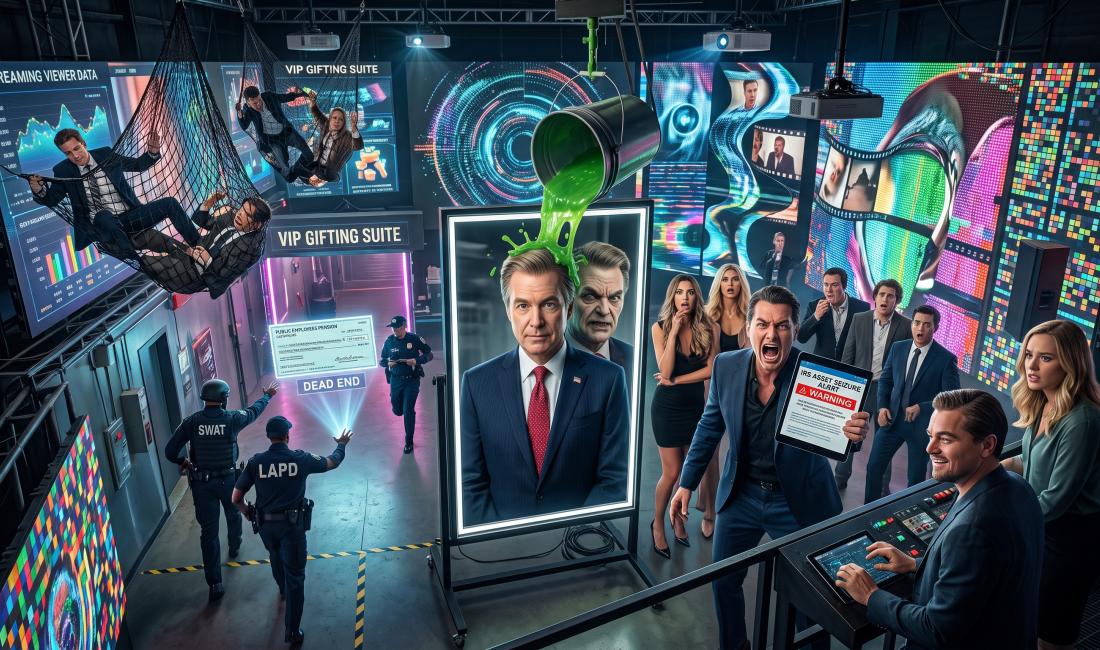
Gov. Harding and Max Vane arrive with SWAT teams, news crews, and Max’s entourage of executives and supermodels. They march into a funhouse of bureaucratic and high-tech nightmares:
-
CHP and LAPD officers chase holographic projections of uncashed pension checks into dead ends.
-
Studio execs are lured into net-traps by illusions of VIP gifting suites and real data on streaming viewership.
-
Gov. Harding, immobilized by seeing his reflection in a deep-fake mirror, has a bucket of prop slime dumped on his hair.
-
Max’s personal tablet, hacked by Leo, displays a forged alert that the IRS is seizing the studio chief’s offshore accounts. Max loses his mind on live television, screams fascist insults at the crew, and admits to his entire scheme.
The live stream breaks the internet. Overnight, Leo monetizes the video as an anti-establishment documentary, earning his artist collective millions directly from global viewers.
Max Vane is arrested for tax fraud and securities manipulation before his jet can leave the tarmac for Monaco. Chase relocates to Atlanta to shoot infomercials. The governor brazens his way through the fallout, runs a leftist-populist presidential campaign, and wins the White House.
As the sun rises over Los Angeles, Margot stands on the warehouse roof with Leo. Free from her dying marriage and the dying Hollywood system, and able to avoid jail time for bribing the local politicians through a generous plea deal, she looks out at a city where the corrupt old ways are finally crumbling—making room for something beautiful and new.