A 1880 Shootout In Rural California Inspired a New Era of Government
This column is co-published and edited with Zócalo Public Square. Photos by Joe Mathews
Remember Mussel Slough!
Easy for me to say. It’s difficult to remember an event that no one ever taught you—even though that event was the massacre that birthed modern California.
Maybe Mussel Slough has been forgotten because it’s hard to find. The massacre site is a field in the San Joaquin Valley, 30 miles south of Fresno. Or maybe Mussel Slough has been forgotten because the powers-that-be want it that way[SR1] .
They don’t want us to remember Mussel Slough, because it would remind us that the U.S. government’s relentless attacks against Californians are not some Trump-era anomaly. They don’t want us to remember that the feds never fight fair, and almost always take the side of a rich and rising industry against the citizenry. And they don’t want us to understand that American rulers never stop trying to blame regular people for the violence their governments visit upon them.
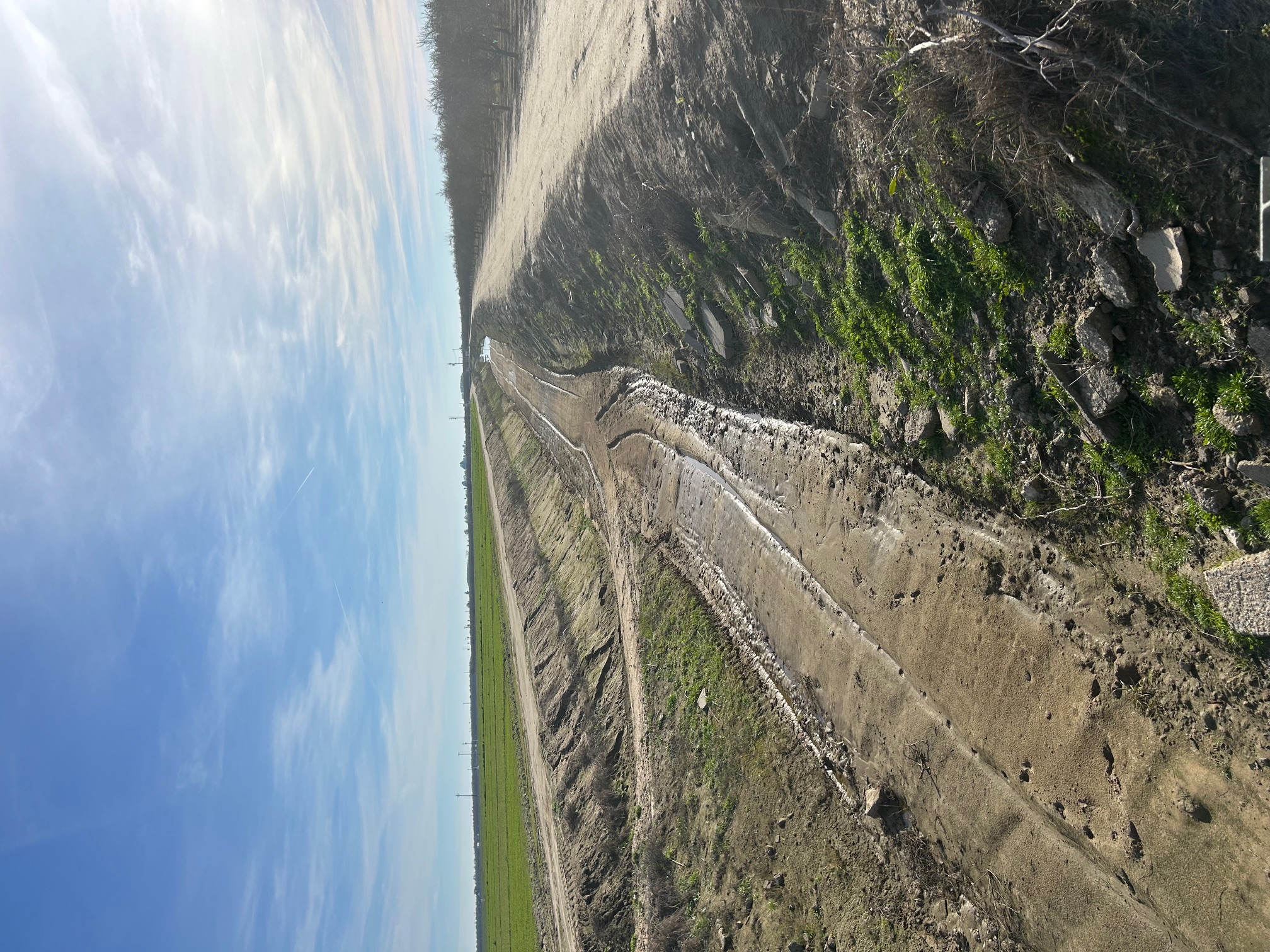
Mussel Slough was the name of a slough, or waterway, between Kings River and Tulare Lake. It was also the site, and then the famous name, of an 1880 shootout between Californians defending their dreams and Southern Pacific Railroad agents, including at least one U.S. marshal.
The details are complicated, and long contested. Settlers had built homes in the area, on railroad land they didn’t own, in anticipation of the construction of a new rail line nearby. This was standard practice. During the fast-paced 19th century construction of new lines across the country, there often wasn’t time for legal niceties. The railroad allowed people to build first and then purchase land from them later, once the railroad route was decided.
But Southern Pacific kept raising the prices in Mussel Slough. The settlers—migrants, Civil War refugees, local merchants, and land speculators—wouldn’t pay, and wouldn’t leave. So the railroad leveraged its power in federal government and in the courts to enforce its control over the land, sending agents to chase after settlers and evict them. The settlers resisted.
The conflict came to a head on May 11, 1880, when five “railroad men”—U.S. Marshal Alonso Poole, Southern Pacific land appraiser William Clark, and locals Walter J. Crow and Mills Hartt (who some accounts describe as deputy U.S. marshals)—started evicting settlers from Mussel Slough.
Twenty or so settlers, who had been attending a picnic, went to confront the railroad men. An argument ensued. One of the railroad men, Harrt, opened fire on one of the settlers, who returned fire, killing Hartt. Crow, another railroad man, then killed five members of the settlers’ party. Another gunfight victim succumbed later. Seven people died in all.
But the railroad men were never held accountable for the settlers’ deaths. Instead, the federal government indicted 17 settlers, and won convictions against five of them for “willfully interfering” with a U.S. marshal.
Southern Pacific’s victories—in the courts, in Congress, and in the Central Valley—stirred national outrage at the government and at wealthy railroad barons. Mussel Slough became a favorite subject of journalists, who crusaded against railroad impunity. Mussel Slought became a fixture of popular culture for a half-century—in plays, early films and books, among them W. C. Morrow's Blood-Money, Charles Cyrel Post's Driven from Sea to Sea, and Josiah Royce's The Feud of Oakfield Creek.
Perhaps the best-known writer to take on the subject was Frank Norris. His 1901 novel The Octopus: A Story of California, a fictionalized account of Mussel Slough, channels despair and outrage at a political and economic system that operates with impunity:
They own us, these task-masters of ours; they own our homes, they own our legislatures. We cannot escape from them. There is no redress. We are told we can defeat them by the ballot-box. They own the ballot-box. We are told that we must look to the courts for redress; they own the courts. We know them for what they are,—ruffians in politics, ruffians in finance, ruffians in law, ruffians in trade, bribers, swindlers, and tricksters. No outrage too great to daunt them, no petty larceny too small to shame them; despoiling a government treasury of a million dollars, yet picking the pockets of a farm hand of the price of a loaf of bread.
If that sense of anger and desperation feels familiar today, it should. The fix is in. The U.S. government violates law and constitution with impunity, and attacks migrants and critics, while Big Tech executives—the railroad barons of today—go unchecked.
That’s why the history that followed Mussel Slough is also worth remembering.
Across California and the U.S., everyday people did not accept federal violence. They fought back, and formed massive movements that birthed the Progressive Era, during which citizens and politicians overhauled the government to make it more responsive to the people. Teddy Roosevelt, quoting Frank Norris and invoking Mussel Slough, took on great trusts and corporate power.
California was a center of the Progressive Era. A new statewide Progressive Party formed to challenge the railroads. The political fight was nasty and at times violent, especially in San Francisco. But the Progressives prevailed.
They established new regulators and agencies to govern California and the railroads. The state legislature and the voters approved women’s suffrage, nonpartisan local elections, and direct democracy.
Californians also enacted sweeping social reforms to benefit everyday people—like the Mussel Slough settlers—including eight-hour workdays, workers’ compensation, child-labor laws, and new food safety and public health systems.
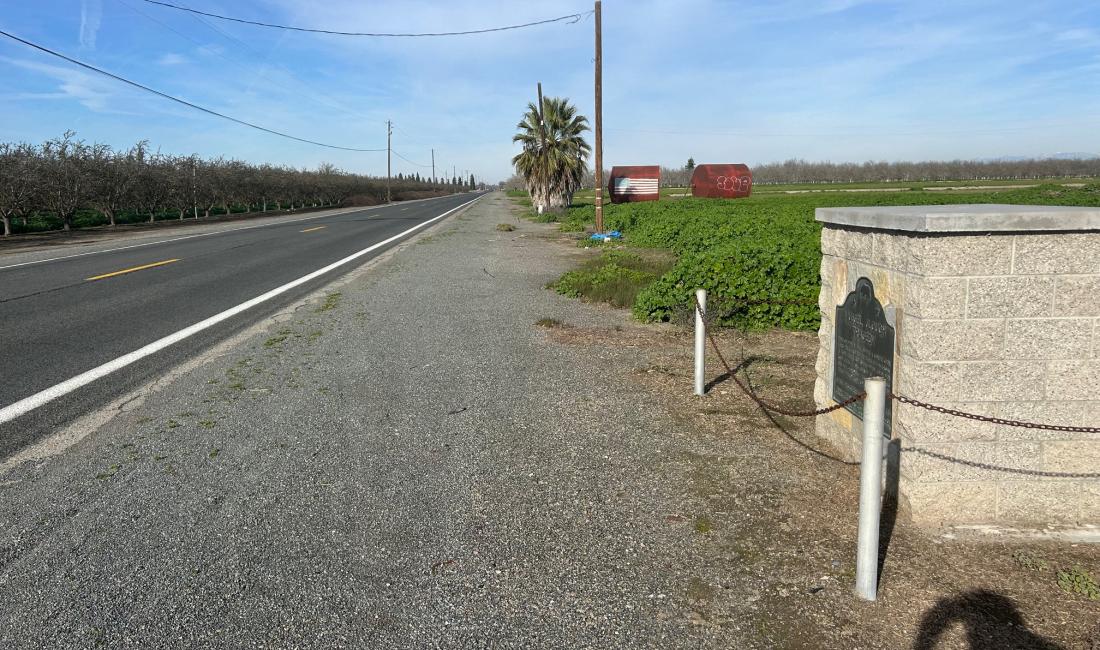
Unfortunately, you learn nothing of this by going to the Mussel Slough site, as I did recently. There’s a historical marker with a weather-beaten plaque, hard by the side of 14th Avenue, with limited information about the massacre. There is no parking lot, so stopping to check out the marker means pulling over into the dirt, with cars speeding past you just a few feet away. There wasn’t much water in a nearby slough.
But there is still plenty of blood in the old story, and no shortage of courage left in us. Fight the Power! Remember Mussel Slough!