Can an Assembly on Vacant Lots Fill the Void?
This column is published and syndicated by Zocalo Public Square. Photo Credit: Tim Walters via Flickr (CC BY-NC 2.0)
Nothing can cure Oakland’s blight—except perhaps its people.
That’s the idea behind the Oakland Civic Assembly on Transforming Oakland’s Vacant Spaces.
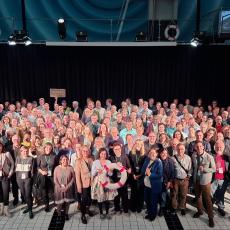
The concept: 20,000 randomly selected households across Oakland have received invitations to participate. From hundreds of replies, organizers are using a sortition lottery to select a demographically representative pool of 40 Oaklanders to serve as delegates. These residents will convene over three weekends late this summer and fall—August 22-23, September 12-13, and October 3-4—earning a $1,350 stipend for their time.
The delegates’ task is straightforward but immense. They will hear from experts, weigh hard data from the Possibility Lab at UC Berkeley, debate competing interests, and forge consensus-based recommendations on how to revitalize commercial strips and convert the city’s vacant lots into vibrant community assets. Institutional backing is robust, spearheaded by the national research-and-action institute PolicyLink and the Democracy Policy Initiative at UC Berkeley’s Goldman School of Public Policy. Healthy Democracy, a nonprofit of experienced assembly designers from the Pacific Northwest, will run the proceedings.
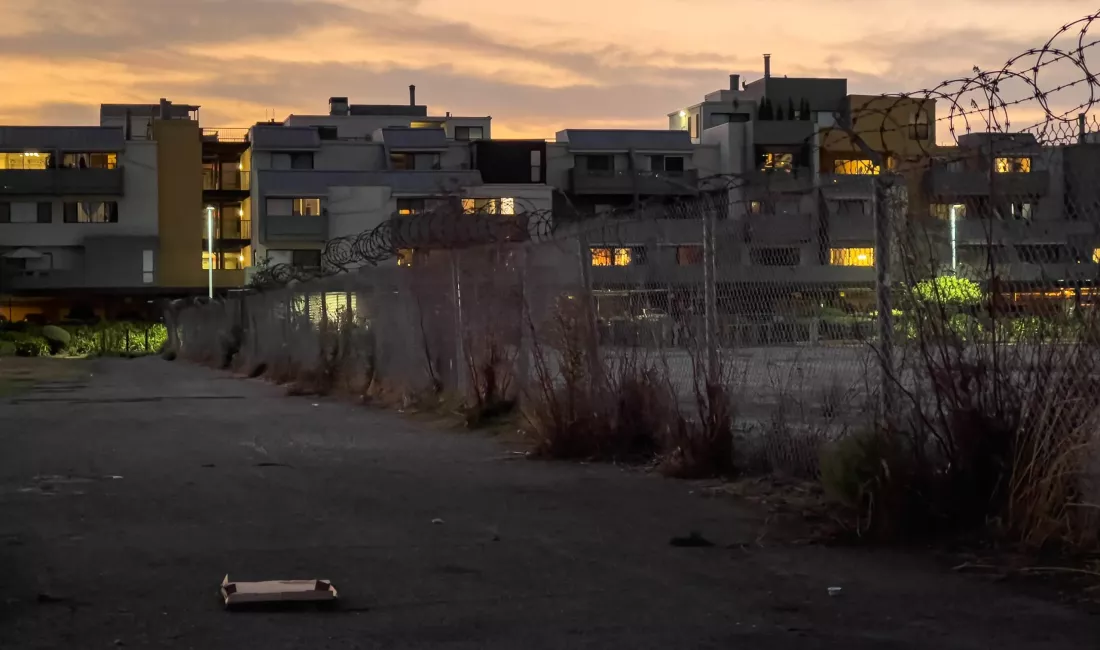
As part of their learning, the assembly participants might consider taking a walk or two around parts of Oakland, to see vacant commercial spaces and empty lots, as I recently did.
Audits suggest Oakland has more than 4,000 vacant lots, about 80 percent of them zoned for residential uses. Most of the lots are smaller than the average Oakland parcel, which means less than 6,000 feet. Polls have shown that city residents want vacant lots to become badly needed housing, but building housing is slow, expensive and legally complicated.
When lots sit vacant for extended periods, they become canvases for vandalism and worse—abandoned cars, mattresses, furniture and hazardous debris. The scope of Oakland’s blight, from West to Deep East, is staggering. Oakland annually receives 25,000 clean-up requests for illegal dumping—an average of 70 every day. City crews must haul away 15 million pounds of illegally dumped trash annually.
The problem is no secret. For years, politicians have campaigned on promises of “clean streets,” and the city’s official strategy keeping vacant spaces clean is the “Three E’s” of education, eradication, and enforcement. But by the city’s own admission, the approach is failing.
Which is why Oakland is handing the vacant lots problem directly to the people.
I know how this deliberative model works because I recently helped organizing a similar civic assembly, using lottery sortition to pick a panel consider reforming the charter of the City of Los Angeles. The logic was similar: Our lottery-selected, representative group of everyday Angelenos focused on the corruption and dysfunction of the city council, because the council refuses to heal itself.
Our assembly in L.A. operated under a compressed timeline to accommodate the strict schedule of the Los Angeles charter commission, which had just 9 months to propose a revamping of the city’s 51,000-word constitution. Despite the hurried pace, the L.A. assembly worked as democratic theorists promise. Citizens eschewed the usual political posturing and provided a remarkably even-keeled assessment of the corruption and underrepresentation plaguing L.A.’s scandal-ridden city council. The 37 delegates combined recommendations that increased the council’s size and representation along with measures to increase oversight and prevent corruption.
The charter commission, appointed by the council, voted to accept our assembly’s recommendations and should have had the power to place them on the ballot for voter approval. But the city council refused to grant the appointed commission that power—because the council wanted to reserve that power for itself. In June, we found out why, when the council refused to put the assembly’s recommendations and the commission’s larger suite of recommendations on the ballot.
In essence, the council blocked reform of itself by referring the strongest assembly recommendations—expanding the city council, switching to ranked-choice elections, and adding oversight to the council through an inspector general—for “further study.”
That’s the standard bureaucratic maneuver for quietly burying good ideas, one that poses a problem for civic assemblies all over the world. Ordinary people do the hard work of finding common ground, only to have the political establishment shelve their solutions.
L.A. is still Chinatown, Jake.
But I’m a bit more optimistic about Oakland, because city leaders there want solutions to eradicate vandalism and waste. In L.A., Mayor Karen Bass wouldn’t acknowledge, much less talk to, the assembly of Angelenos doing charter work for her city. Oakland Mayor Barbara Lee is actively supporting the process.
Having genuine city leadership buy-in changes the entire calculus for a civic assembly. Citizens’ recommendations then carry immediate political weight.
If a room of lottery-selected residents can figure out how to solve the intractable problem of vacant lots, rusted cars, and vandalized storefronts, it won’t just clean up Oakland. It might demonstrate that best way to fix a broken city is to let its people take charge.