Gabriel Kahan's Creative Assemblies Get Cops, Screenwriters, and Localities to Come Together and Listen
This column is co-published with Zócalo Public Square. Photos by Joe Mathews and courtesy Gabriel Kahan.
If justice wears a blindfold, maybe the rest of us should too.
That’s just one of the lessons I’ve learned from watching Gabriel Kahan lead democratic processes called creative assemblies.
Kahan is an unusual figure in California, and in the democratic world. Democratic processes that engage regular people, instead of just politicians, are growing more popular in the U.S.—from participatory budgeting (a Brazilian invention) to deliberative assemblies (from Europe and Japan).
But Kahan, working in Southern California, has invented his very own method for helping people bridge divides and understand the problems of local communities. And he has applied it in dozens of convenings within institutions from the Los Angeles Police Department to Hollywood, and in places from Bel Air to Watts.
His “creative assemblies,” as he calls them, have a California flavor, fusing art, pedagogy, collective technology, and yes, sometimes, blindfolds.
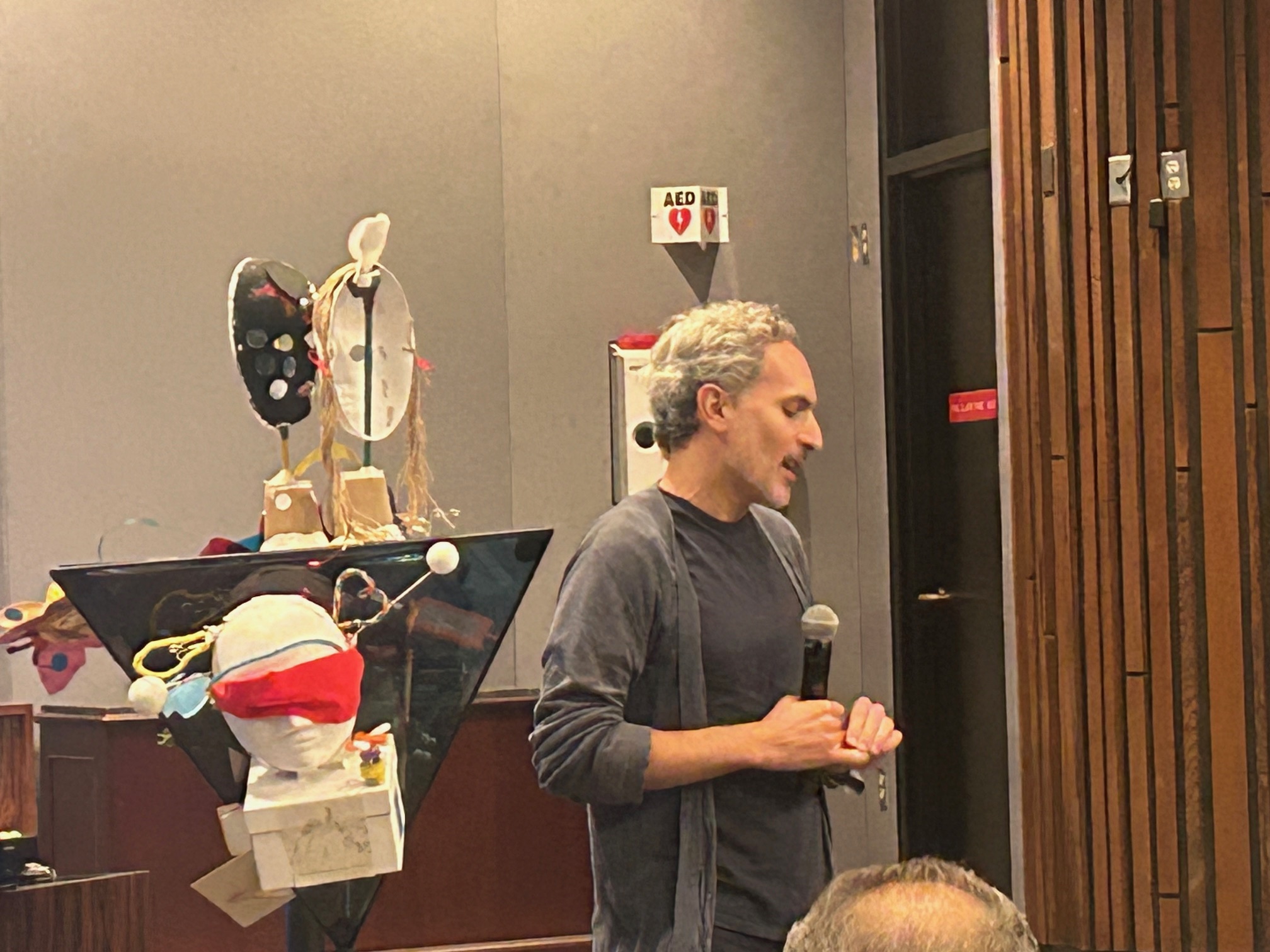
Kahan asks participants to don blindfolds at crucial moments of group conversation to get them to listen more closely. Free to look around, people in a group listen less, he has found—they glance at their neighbors, or get lost in their own thoughts, planning what they’ll say next. They are also more likely to interrupt each other.
In a world where we rush to judge, waiting to speak rather than listening, the removal of sight forces a rare form of attention. Blindfolded participants wait for sentences to end, and critically, absorb more of what their fellow assemblymembers are saying. They also feel less fear of judgment or intimidation from non-verbal cues.
“The blindfold really helps remove the pre-conceptions from others before you start to speak,” said then-City Councilmember Victor Manalo during a creative assembly Kahan led in Pomona in 2024. “Listening is so important, and allowing people to finish their comments before you jump in really means you’re taking in what they’re saying.”
I got to know Kahan when we overlapped as L.A.-based democracy fellows at the Berggruen Institute, an independent, future-focused think tank. Berggruen has sponsored many of Kahan’s convenings, which are mostly private, along with foundations and some governments.
Kahan’s life path, like his assemblies, is unusual. Originally from Mexico City, Kahan was a documentary filmmaker and educational technologist before arriving at MIT’s Art, Culture and Technology program as a researcher-lecturer to learn more about systems design and art’s power to reshape the mind.
Working with an engineering professor, he developed a collaborative learning method to help diverse groups think through possible designs for complex systems and problem solving. One crucial lesson they learned: People who didn’t get along could come together by creating art together.
More than a decade ago, family reasons brought Kahan to Los Angeles, where he began working with the City of L.A.’s neighborhood councils. These 99 councils have struggled to find common ground and make more impact on city policy, and some turned to Kahan. He held five assemblies in Watts, and then follow-up projects with a gang task force, and the Crips. The goal was to bring Black and Latino neighbors together to make their neighborhoods more peaceful.
Kahan, quiet and unassuming, does not pursue particular policy changes. He says it is challenging enough to get people to stay in the same room, for hours or full days, for multiple meetings. His goal is to help participants understand each other—by creating space in the mind
for ideas and ways to navigate complexity creatively.
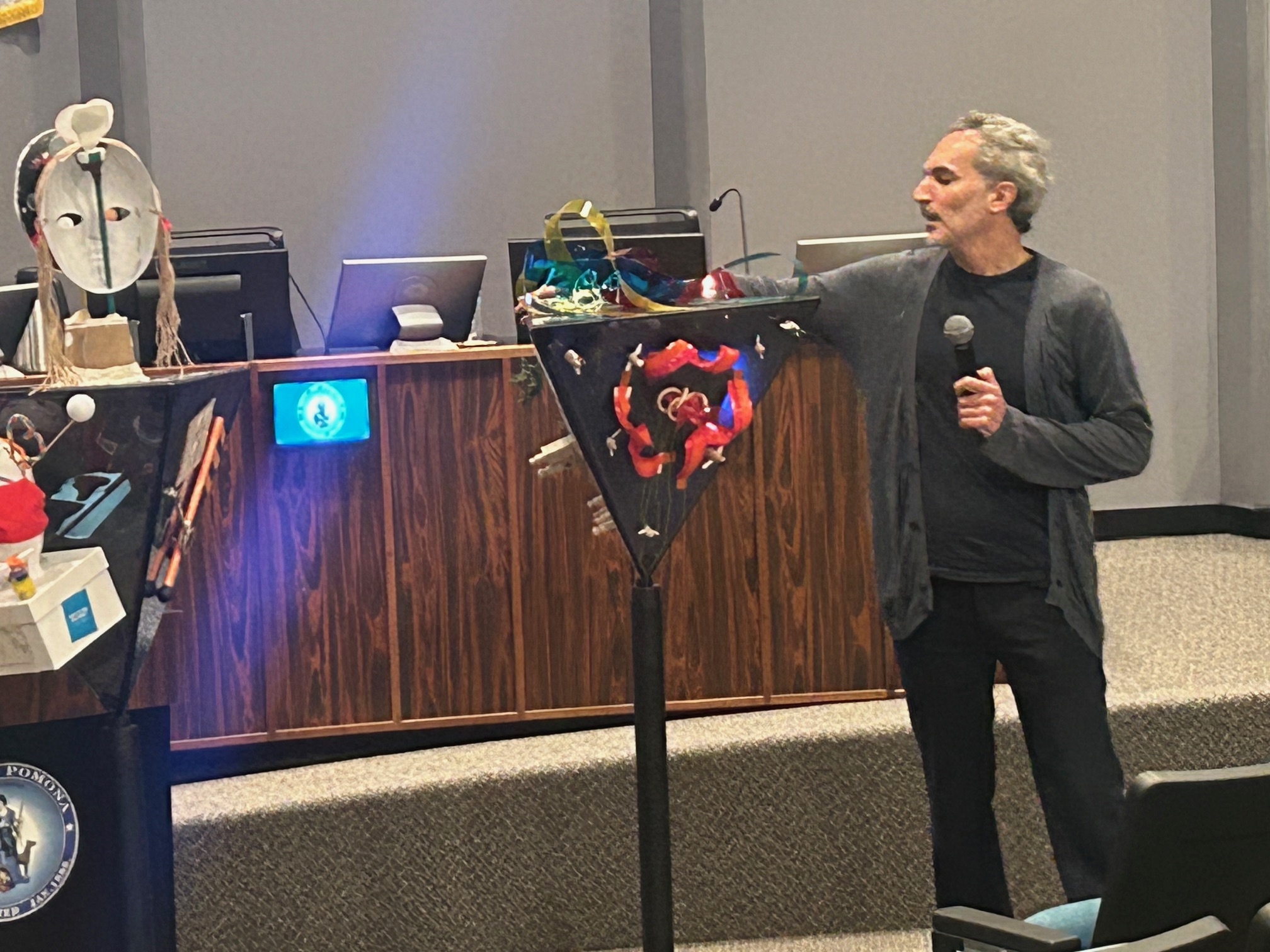
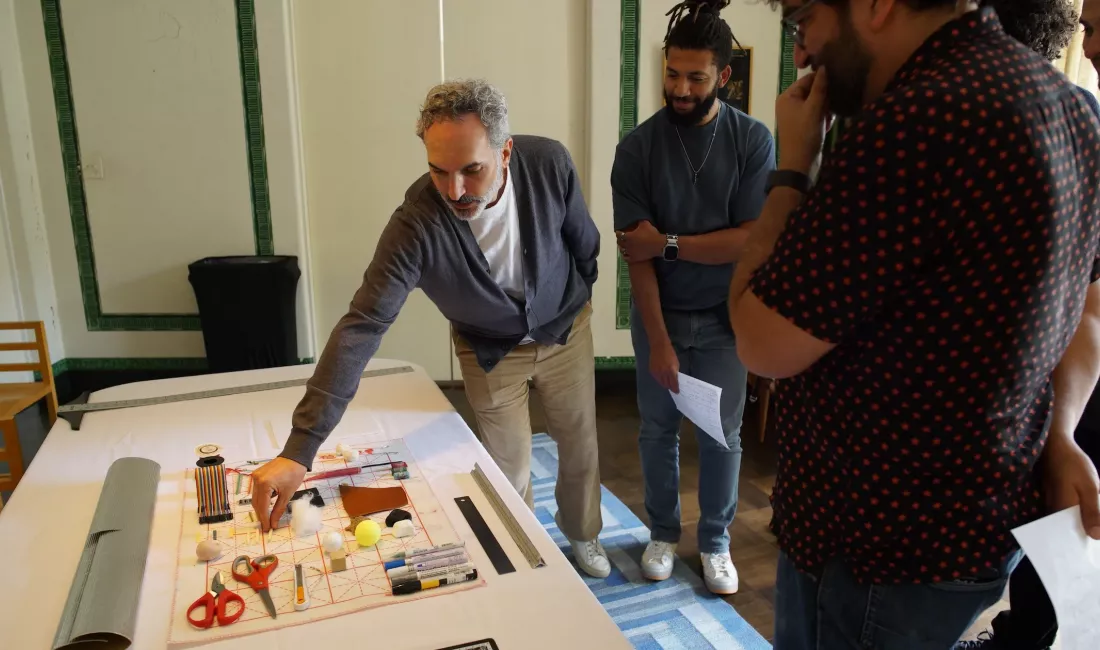
His methods in these “creative assemblies” go beyond conversation and blindfolds. People in assemblies build sculptures together—attaching mixed media materials, and their own items and drawings, to acrylic and steel frames. The artwork helps people visualize the interconnectedness of mutual problems; the sculptures embody concepts for addressing divisive issues between antagonistic world views.
Kahan says that, as people create together, they develop collective intelligence—allowing them to see their true place in community, develop stronger voices, and think differently.
“It’s all meant to create the space for new forms of thinking,” Kahan explained during a creative assembly I attended last year on AI and Hollywood. “I know this can seem a bit bizarre, but it breaks power structures and preconceived political concepts between people, and inverts perspective.”
He draws little media attention, even when he works on hot-button topics. In the wake of George Floyd’s death, he spent two years convening assemblies with the LAPD. At first, these focused on problems in police–community relations. But as assemblies continued, and top cops put on blindfolds, they revealed that problems with community were often rooted in internal department conflicts between commanders and rank-and-file officers.
One result of these assemblies was that LAPD gave its officers more freedom to exit their vehicles and engage in “walk and talks” with everyday Angelenos to build rapport and understand community concerns. “The creative assemblies are improving public safety,” then LAPD Chief Michel Moore told the police commission in 2021. “It’s a joint effort for finding areas where the community and police officers can work together.”
Kahan’s assemblies can seem prophetic. Two years before the January 2025 fires, he ran assemblies on fire risks in hillside communities on L.A.’s Westside, in which fire experts and communities learned that they weren’t prepared for larger blazes.
Kahan and experts simulated a fire with 50 mile-per-hour winds, which could wipe out whole neighborhoods. But local emergency officials, presented with the findings, dismissed the exercise, arguing that the simulated fire was unrealistically powerful. The fire in the Pacific Palisades, whose residents were not part of Kahan’s assembly, had winds of more than 80 miles per hour.
Kahan also is taking on AI. At a 2025 assembly I attended, he brought together technologists and Hollywood creatives from film, TV, and music, with support from the Mozilla Foundation and the Berggruen Institute. The stated goals were to develop a shared understanding of the challenges of AI, and to build technologies that protect creators’ interests. In those assemblies of glossy Hollywood types, the soft-spoken Kahan resembled a slightly mad scientist, with curly gray-white hair, mustache, stubble, and a natural expression of surprise.
Initially, he got puzzled looks after urging participants “not to talk about futures”—isn’t this about the future, Gabriel?—“because no one knows the future, and talking about it just becomes a fear hole.” Instead, he advised them to talk about their own individual experiences.
They did. The assemblies produced a report listing “Hollywood’s 8 Rules for AI,” to frame solutions to the problems AI poses for those who work in film, television, and new media. The eight rules influenced legislation passed last fall by the California legislature.
Kahan’s approach was similar during four creative assemblies he held on early childhood development, with UCLA’s Center for Healthier Children, Families and Communities, in late 2024 in the city of Pomona.
Mayor Tim Sandoval said the sessions, which included one Spanish-language assembly, and brought together a diverse group of residents, city, and school officials, changed civic engagement in Pomona. “We need to be asking the questions of citizens more,” he told me. He also credited the assemblies for surfacing ideas, including handing out care packages for newborns, with diapers and a thermometer. The assemblies also revealed deep concern about open sex-trafficking along Holt Avenue, prompting more enforcement there.
At the final convening, participants from the four different assemblies came together to compare sculptures. They tried to identify a concept that would guide future action and collaborations. Caring? Vulnerability? “Honesty,” suggested Kahan.
“If we’re not who we are,” he said, “the information that we’re sharing isn’t really ours.”