California Trends Toward 'The Dude' of Cult Film
This column and image were published by Zócalo Public Square. You can support Zócalo here.
I write this wearing a baseball cap that says, “I Told You So.” The hat’s main purpose is to remind my three teenage sons to listen to their father. But sometimes, as in this column, I aim the message at all of you, my fellow Californians.
Twelve long years ago, I was the first to warn you of the creep of a dangerous new disease:
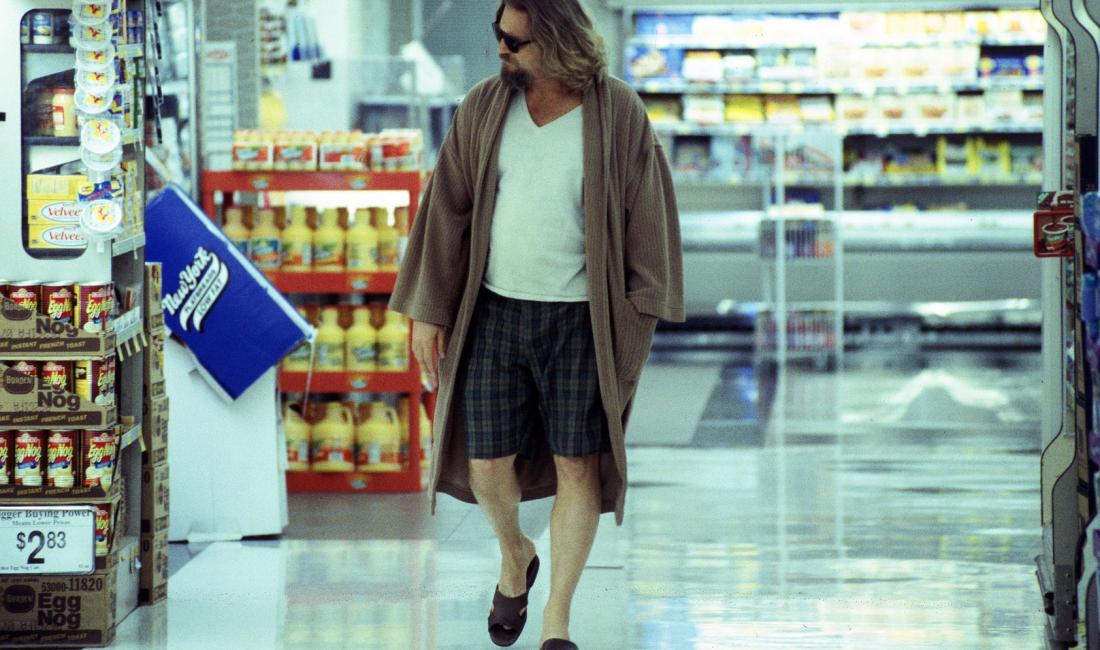
That’s my term for the bummer-fact that Californians—who like to think of ourselves as young and diverse and hip—are coming to resemble Jeffrey Lebowski, aka The Dude. Played by Jeff Bridges in the 1998 cult film The Big Lebowski, he is an aging, bowling, cocktail-drinking, Creedence-loving, underemployed stoner who retired the trophy for most laidback Californian ever.
I thought my warning would inspire a cultural U-turn, a reversal in mores, a return to harder work and healthier living among the square community. Instead, quite tragically, you ignored my warning, perhaps more concerned by the supposedly greater threats of fire, debt, or Trump.
Left unchecked, Lebowskization is no longer creeping. It is spreading faster than Ebola. No dude, dudette, or dudex in California can escape.
Some might object, or say, “Well, that’s like just your opinion, man.”
But the Dudeian economic figures are a freakin’ travesty.
Lebowski used to stand out because he didn’t hold a steady job. Today, that makes him mainstream. Some 10% of California adults are unemployed or underemployed, according to the Public Policy Institute of California. On top of that, another 11% of the state’s workforce is primarily self-employed, and nearly two thirds do independent contracting or own unincorporated businesses, like the Dude.
Lebowski was a private detective, unlicensed, a booming profession in California, according to the Bureau of Labor Statistics, with the highest concentration of private investigators in the U.S. He dressed very casually at work, often in baggy shirts and shorts—like your columnist, but without the “I Told You So” cap—long before it became commonplace. And, in the course of his investigations, he inadvertently dabbled in the world of homemade pornography, anticipating the rise of the OnlyFans economy by more than two decades.
The Dude’s cultural passions have been widely embraced, starting with his relaxed relationship with marijuana. Since the 2018 legalization of recreational use, total annual cannabis consumption in California has grown to a staggering 3.8 million pounds (the majority of which is still unregulated, like the Dude’s), according to state figures. In 2015, 15% of Californians 12 and older had used marijuana in the past year. In 2025, one study found that 37% of Californians reported using cannabis in the prior three months, with a high prevalence of daily use among adults.
The Dude also enjoyed imbibing, and so do we. Despite a decline in wine-and-beer drinking, consumption of spirits reached its highest rate since the mid-1980s in 2024, with the average Californian drinking two gallons of liquor each year. This volume growth is due lrgely to the booming ready-to-drink (RTD) category of canned cocktails. Naturally, that includes White Russians, the Dude’s drink of choice.
People often drink while bowling, which may be why the Dude’s favorite sport is experiencing a modest resurgence. While traditional leagues are declining, the sport is surviving by pivoting to upscale boutique bowling alleys that emphasize premium dining and craft cocktails. Despite old-school alley closures, the national bowling center market is growing and valued at $20.33 billion.
The Dude’s other life choices have also become more popular. He drove a battered, exhaust-coughing 1973 Gran Torino, which might seem out of a fashion for climate-aware, fossil-fuel-fearing Californians. But the average age of a California vehicle has reached 12 years.
Lebowski’s famous taste in floor coverings—the film’s plot is driven by the theft of the used Persian rug that “really tied the room together”—is also being adopted. The secondhand furniture market, fueled by online resale platforms, has become a $50 billion market in the U.S. Area rugs also have grown more popular, to add warmth to in an era of hard-surfaced flooring.
We are also mirroring Lebowski in our philosophical pursuits. Back in 1998, The Dude was the rare Californian to be at war with nihilists, who blew up his car. Today, national authorities are warning about a surge in “Nihilistic Violent Extremism.” Psychologists warn of a sense of hopelessness among the young that is aptly described as “nouveau nihilism.”
Perhaps seeking answers, UC Berkeley students have gone against the STEM-grain in this decade, surging into humanities majors, with philosophy applicant pools hitting highs. UCLA and UCSB hand out more philosophy degrees than almost any school in the country.
Less intellectually, and not so romantically, Californians and our fellow Americans, following the lead of confirmed-bachelor Dude, are in a “dating recession,” in part because of the costs. (Yes, The Dude conceives a child with the artist Maude, but that’s very much a spur-of-the-moment thing.) Governor Newsom has been raising alarms about a survey showing nearly half of young men have never asked a woman out on a date. One downstream effect: the percentage of currently unmarried Californian adults has surpassed 50%, and 38% of the state’s adult population has never tied the knot.
As a result, more Californians are living alone as the state ages rapidly. When he played the Dude, Jeff Bridges was 48 years old. He’s now 76—putting him in the fastest growing demographic here, Californians over 65. By 2030, older adults will outnumber those under 18 for the first time in the state’s history.
Where will we lay our heads in our dotage? Like the Dude, we struggle to pay the rent, as more of us, 44% according to 2024 figures, are renters as the Dude was. And 56% of those renting households are rent-burdened, spending more than 30% of their income on housing.
As a result, displacement is rife in coastal neighborhoods. The population of Malibu—from which The Dude was ejected by local police—has fallen from more than 14,000 at the end of the century to barely 10,000 today.
Lebowski is not always a prophet. The music of the Eagles, hated by the Dude, is still breaking sales records. But in almost every other way, Lebowski represents who we are, and where we are heading.
Our state of Lebowskis may be abiding. But we aren’t thriving.