Helene Landemore's "Politics Without Politicians" has the right diagnosis, but a narrow cure.
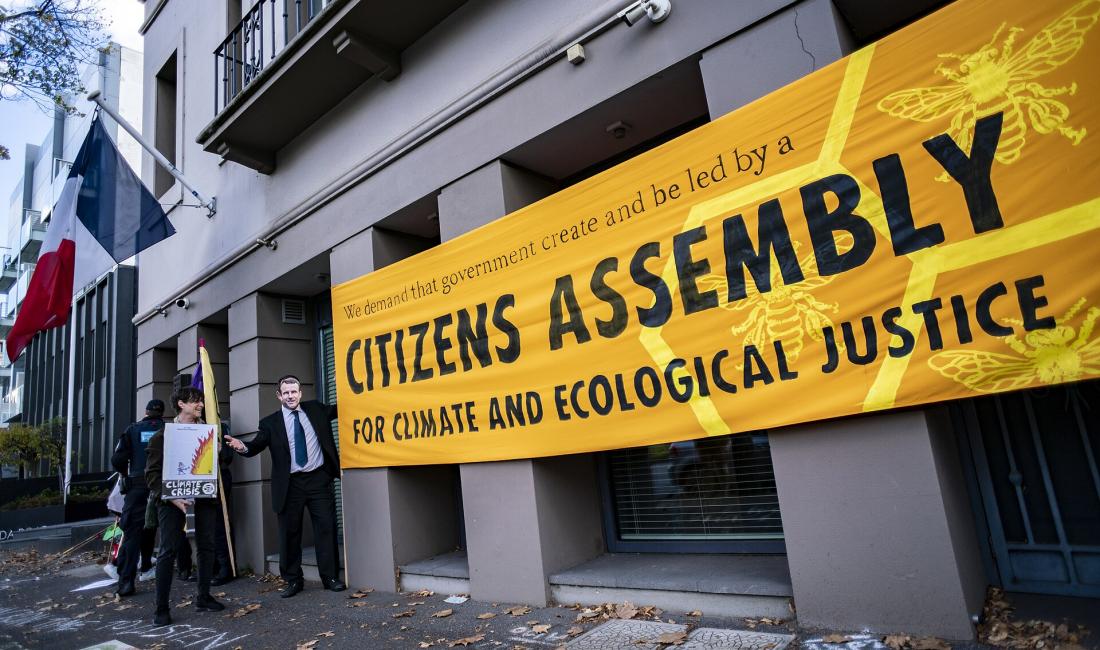
CC BY 2.0. Photo by Extinction Rebellion
For decades, the standard response to the world’s democratic crisis has been remedial. If the system is broken, we are told to fix the plumbing: cap campaign donations, boost disclosure, or find better candidates.
In her powerful new book, Politics Without Politicians, Yale political scientist Helene Landemore argues that we are wasting our time with the pipes when the entire house is built on a sinkhole.
Landemore’s writing style is open and personal. And early in the book, she confesses to having spent years resisting the conclusion she embraces in this tome. The problem with democracy isn’t just "money in politics" or "uninformed voters." The problem is professional politicians and the mechanism that creates them—the election.
“Democracy, as it stands, has long been defined by elections, parties, and elites,” she writes. “But it’s time for a Copernican revolution—one that places ordinary citizens back at the center of the democratic universe.”
Landemore’s critique of our current system is a powerful, almost forensic, dismantling of the Schumpeterian conventional wisdom about democracy. For Joseph Schumpeter, the early 20th century Austrian political economist turned Harvard professor, democracy was little more than a competitive struggle between elitesm with the masses only occasionally chime in with a vote.
Landemore demolishes that view. Channeling the late French political philosopher Bernard Manin, she highlights a forgotten historical truth: the founders of modern representative governments, chosen through elections didn't see themselves as creating "democracies." They were creating the opposite of democracy. Since ancient Athens, elected representative governments have been seen as fundamentally oligarchic, because they favor those with the resources, the ego, and the "superior" social standing to run.
Landemore doesn't pull her punches regarding who ends up in power. Quoting political scientist Brian Klaas, she notes that elected offices tend to attract psychopaths who want to control others. When we rely on self-selection for leadership, we don't get a mirror of the population. We get a distilled concentrate of the most ambitious and pathologically confident.
And those people don’t much care what we think. Citing the famous Gilens-Page study she writes that in the United States, there is almost zero correlation between what the majority of the public wants and what the government does—unless those preferences happen to align with the wealthy. Our current “politics with politicians’ is a card game where the house always wins.
If the election is the disease, Landemore’s cure is sortition. Specifically, she proposes to use sortition lotteries to select ordinary citizens to form assemblies to deliberate on public questions. She frames this as a transformation from the politics of ego to a politics focused on empowering the shy.
Inspired by G.K. Chesterton’s idea that real democracy should act like a "jolly hostess" who warmly welcomes shy people to parties, Landemore envisions a system where the quietest voices are given the structural support to speak.
To explain how this might be possible, she takes us deep inside two landmark French assemblies: the Citizens’ Convention for Climate and the Convention on the End of Life. Landemore details the flaws of these bodies. But she also describes how the people selected for these assemblies bond across differences to find “love and emotional support.”
Yes, there is love in democracy. She recounts moving scenes that challenge cynical views of modern political discourse: There’s the widow who, while participating in the End of Life assembly in Paris, is accompanied on visits to her husband’s grave by ten other randomly selected citizens in a show of solidarity. In the Philippines and Colombia, she cites examples of victims and perpetrators—or drug dealers' families and their victims—finding common ground through the sheer act of structured listening.
Landemore argues that these assemblies aren't just fairer. They’re smarter, because of the power of the “cognitive diversity” of lottery-selected groups. Sshe argues that a group of "ordinary" people who think differently will out-solve experts who all went to the same elite universities.
Landemore is well-aware of the standard objections to lottocracy. Critics argue that giving power to a random group of 150 people robs the remaining millions of their agency. If I didn't vote for them, why should they speak for me?
Landemore counters this with a proposal to combine assemblies with direct democracy. She imagines a legislative body, selected by lot, that must send its proposals to the whole population by referendum for ratification.
She writes that an individual citizen would have more agency in this system over a lifetime—having a high chance of serving in a local or national assembly—than they do by merely following politics in the media and casting a ballot once every four years.
That feels overstated. For all its brilliance, the book suffers from a profound myopia that is commonplace in the worldwide movement for more deliberative democracy. I say this as someone who is active in that movement, and recently organized the first such assembly in Southern California. Our assembly produced a few useful suggestions for restricting the city council in Los Angeles, but our assembly was surely not a new system of government.
Still, Landemore, like the deliberative movement, portrays the assemblies as the main, even exclusive solution, to our politician-driven politics. This is exaggeration—and a glaring contradiction. Because every successful assembly she cites to promote the assemblies was born from and filtered by the very politicians she wants to eliminate.
As Landemore herself acknowledges, Ireland—a "gold standard” for these assemblies—is the country least likely to move toward “politics without politicians” because the assemblies have actually restored trust in the existing political class. If the goal is to abolish politicians and pursue new avenues of governance, why is her preferred method—the assembly—acting as life support for the status quo?
An even bigger conceptual failure of the book is its failure to reckon with the technocracies that are at the heart of 21st century government. Landemore directs her jeremiad at politicians even though the real architects of modern life are regulators and judges, as well as the lawyers, lobbyists, philanthropists, corporations, and NGOs that operate outside our government. These are the people who write the actual text of the laws—the thousands of pages of code that dictate everything from environmental standards to tax law. They are not elected, but they aren't ordinary citizens either.
In this context, assemblies feel like weddings. And deliberative democracy people are largely wedding planners, focused on these events. But what democracy needs are marriage counselors, who could might bring everyday people, and their ideas, into the lobbies and bureaucracies that really rule.
Instead of expensive, 150-person assemblies promoted in this book, we need a co-cretion model that has everyday people imagining and drafting new laws together with technocrats, negotiating directly with lobbyists, and implementing more services themselves.
Despite its contradictions, Politics Without Politicians is a vital book. Landermore is right that too many of us see democracy as something we watch in the media, rather than something we must do ourselves. Her description of the "therapeutic effect" of deliberation—of people learning to respect, and even “love” each other—is a much-needed antidote to the rage-fueled incentives of the digital age.
She calls for a world where democracy is a "daily practice," modeled at home, in the office, and in the street. Even if her vision of a world ignores the lawyers and technocrats lurking in the wings—it challenges us to ask a question we’ve been avoiding for too long.
Why are we still hiring people to represent us, when we are capable of doing the job ourselves?