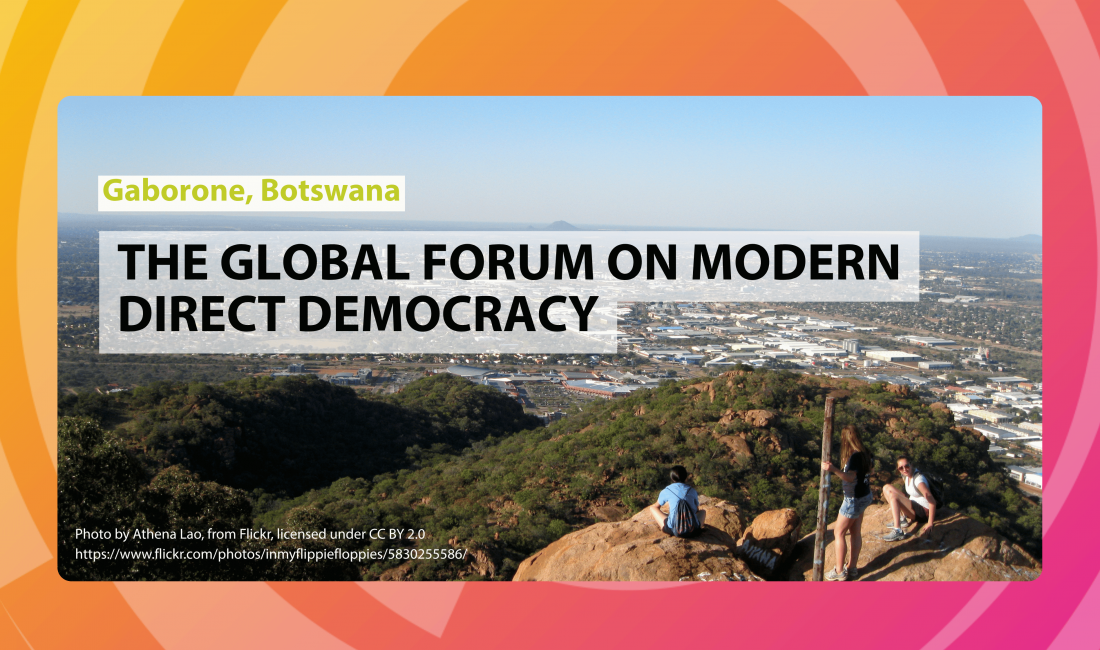
Ahead of the 2026 Global Forum on Modern Direct Democracy, Democracy International looks at the country that will host it and finds a democracy with a story worth telling.
There are countries that talk about democracy, and there are countries that live it. This October, when delegates from around the world gather in Gaborone for the Global Forum on Modern Direct Democracy 2026, they will be arriving in one of the latter.
A democracy older than most of its peers
Botswana's democratic story begins at independence in 1966, when the country emerged from colonial rule as one of the poorest nations on Earth, landlocked, arid, with barely a handful of kilometres of paved road. What it lacked in infrastructure, it made up for in institutional discipline. Rather than sliding into the one-party rule or military intervention that swallowed so many post-independence African states, Botswana held elections every five years, without interruption, for nearly six decades. By the time the 2024 general election came around, it had run thirteen consecutive national polls since 1965, every one of them peaceful.
That consistency alone would make Botswana unusual on the continent. But it is what happened in October 2024 that turned Botswana from a quiet success story into a genuine case study in democratic maturity.
The test every dominant party eventually faces
For 58 years, the Botswana Democratic Party governed without interruption, long enough that many observers assumed the country's democracy, however clean, had never truly been tested. A political system only proves itself in the moment power actually changes hands.
That moment came on 30 October 2024. In an election that drew turnout above 80%, the opposition Umbrella for Democratic Change, led by human rights lawyer Duma Boko, swept to a decisive majority. President Mokgweetsi Masisi, defeated at the polls, did not contest the result, delay the transition, or challenge the legitimacy of the process. He conceded on national television within days, telling the country: "I am proud of our democratic processes, and I respect the will of the people." Boko was sworn in shortly after, calling the transition proof that Botswana had "become an intriguing case study in democracy in action."
For a region where incumbents have too often clung to power through courts, constitutions, or force, Botswana's transition stood out precisely because it was unremarkable: a government lost an election and left office. That it happened so smoothly, in full public view, is exactly why it mattered so much.
Consensus in the blood
Part of what makes Botswana's democratic culture distinctive predates the ballot box entirely. The kgotla, the traditional public assembly where community matters are debated openly and decisions reached by consensus, has functioned for centuries as a forum where ordinary citizens, chiefs, and leaders speak as equals. That tradition of open deliberation is often credited with shaping the political culture that allowed multiparty democracy to take root so durably after independence, long before "citizen participation" became an international buzzword.
Why Gaborone, why now
It is fitting, then, that Gaborone will host the Global Forum 7-10 October under the theme "Indigenous. Resilient. Empowering." Few venues could embody that theme more literally. Civil society, policymakers, government representatives, journalists, international organisations, academics, activists and practitioners from around the world will come together and discuss referendums, diaspora voting, and citizen participation in a country that has just lived through a textbook demonstration of what a functioning democratic transition looks like, and one whose deliberative traditions run deeper than its written constitution.
Botswana is not a perfect democracy. No country is, and the Global Forum's discussions will be richer for engaging honestly with the challenges that remain. But as a host, and as a case study, it offers something rare: a democracy that has been quietly getting the fundamentals right for sixty years, and that just showed the world exactly why that patience pays off.
The 2026 Global Forum on Modern Direct Democracy will take place in Gaborone, Botswana, from 7 to 10 October 2026, hosted by the University of Botswana in partnership with Democracy International.