Indonesia's Devastating Flash Floods Traced to Disappearing Forests
Essay and images by Asia Democracy Chronicles. Photo by Garry Lotulung
Anyone still in doubt about the negative effects of deforestation need only to look at communities in Sumatra, one of Indonesia’s main islands, after Cyclone Senyar smashed through them last November. Even months after, scores of families there remain in makeshift shelters, many roads are still impassable, and much of the affected area is like an endless lumpy sea of brown.
Aid began trickling in days after the cyclone hit, but it has taken the speed of turtles to reach the people. The debris brought by Senyar-triggered flash floods into the villages have made moving in and out of Sumatra much like tackling a giant obstacle course, and it may take some time to clear it completely.
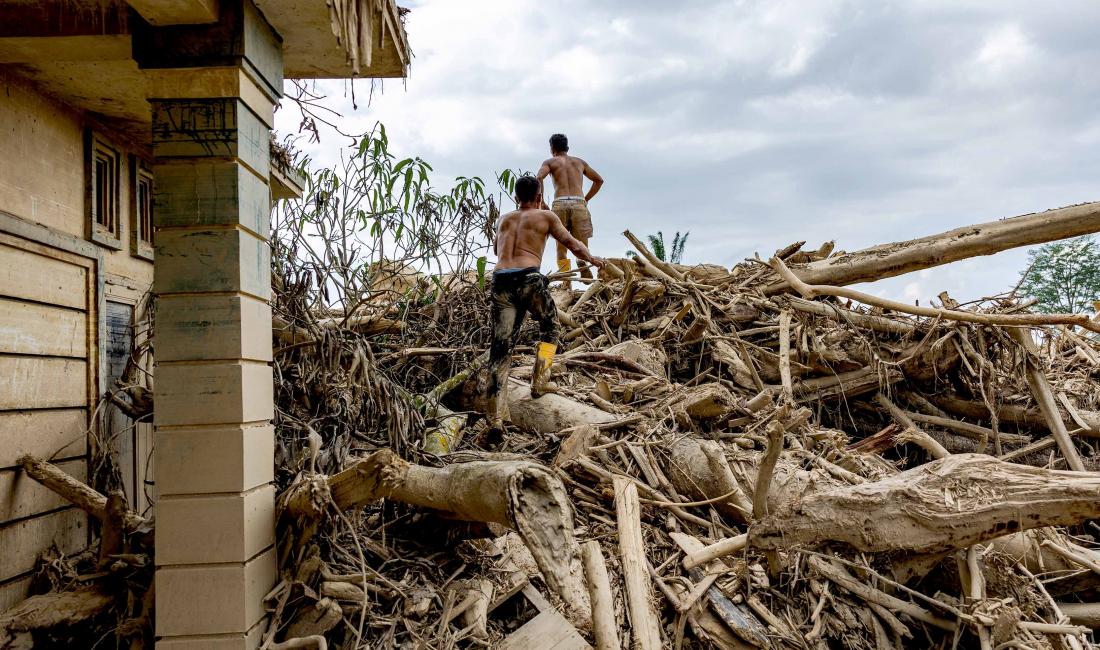
When Asia Democracy Chronicles (ADC) flew a drone over the affected areas more than a week after the Nov. 26, 2025 cyclone, the images it captured showed field after field of largely mud and logs. Here and there some houses and other buildings peeped through, but a closer look revealed most of them missing walls and having wide gaps in their roofs, as well as damaged doors and blown-out windows. Electric posts were slumped on the ground, their wires tangled up with all kinds of trash.
Many houses were also buried in mud mixed with logs and wood pieces big and small, leading one to wonder how their occupants had fared while the floodwaters churned around their homes and chunks of felled trees pummelled them. According to locals, it took two days before the floodwaters finally subsided.
Senyar had also rampaged through parts of Malaysia and Thailand. It brought destruction and death there as well, but not at the scale experienced by communities in Aceh and North and West Sumatra. The estimated total death toll in these Indonesian provinces because of Senyar and the flash floods is more than 1,204. Hundreds remain missing, while countless suffered injuries and trauma.
ADC found Siti Basmallah living in a tent, just meters from what used to be her home. Nearby was the river that had overflowed and carried giant logs and other debris into Babo village in Aceh Tamiang Regency.
“I lost my husband, and our house is damaged and filled with mud,” said Siti Basmallah. “I saw the flood reach 15 feet (nearly 4.6 meters) above our houses. Villages turned into rivers, and homes were destroyed.”
In Tanjung Karang, another Aceh Tamiang village, a four-meter-high log pile covered some two hectares. Syahrial Umar said, “Our settlement was destroyed as if by a tsunami. Many victims are still missing and hard to find.”
“I saw many logs carried away by the flood,” he added. “They came from upstream, likely due to logging.”
Less and less forest cover
The cyclone had been unusual for that time of the year, and many have pointed to climate change as the major culprit for it and the large amount of rain that it triggered. But academics and environmentalists alike say that deforestation is more to blame for the tragedy that befell Sumatran villages – a tragedy that they say is likely to recur if the central government fails to make major policy reforms.
In a December 2025 report, the international environmental group Greenpeace said that based on data from the Ministry of Forestry for the period 1990-2024, many natural forests in North Sumatra Province have been converted to plantations, dryland agriculture, and tree plantations.
A similar situation is also occurring in Aceh and West Sumatra, it said, and land conversion is taking place as well in watershed areas.
Dr. Hatma Suryatmojo, a hydrological and watershed conservation researcher at Gadjah Mada University (UGM), said that in the floods that inundated parts of Sumatra as a result of Senyar, “extreme weather was only the initial trigger.”
“The destructive impact,” he said in an interview posted on the university’s website, “was greatly exacerbated by the weakened natural defenses in the upper watershed.”
Suryamojo explained that “forests maintain the balance of the water cycle, preventing floods during the rainy season and sustaining baseflow during the dry season….(When) upper-watershed forests are degraded or cleared, the natural hydrological cycle becomes disrupted, and these functions are lost.”
For his part, Sapta Ananda Proklamasi, senior researcher of the Greenpeace Indonesia Forest Campaign Team, told ADC that most Sumatra watersheds are in critical condition, with natural forests covering less than 25 percent.
“Now, only 10 to 14 million hectares of natural forest remain in Sumatra—less than 30 percent of the island’s 47 million hectares,” he said.
If forest cover is less than 30 percent, it indicates deforestation, he said. The decrease in forest cover must be taken seriously, said the Greenpeace researcher, as it affects the environment’s carrying capacity and resilience.
He also said that the large number of small and large pieces of wood swept away by the floods in Sumatra needs to be thoroughly investigated. These wood pieces could be due to logging, fallen trees, or land clearing, noted Sapta.
Faulty laws and policies?
In what some take as an acknowledgment of deforestation’s role in Sumatra’s still ongoing crisis, President Prabowo Subianto recently revoked the operating permits of 28 companies found to be in violation of rules and regulations covering economic activities involving natural resources. Yet experts have joined rights organizations in saying that Indonesian laws and state policies are the main problem.
For instance, according to Dr. Suyatmojo’s UGM interviewer, the expert had cited weak land-use planning and control for enabling “widespread forest encroachment, conversion of forest land into oil palm plantations, and illegal logging in the upper watershed, key drivers behind the frequent hydrometeorological disasters” in Sumatra.
Transparency International has gone further by alleging corruption as well. In a press release issued last December in response to the devastating Sumatra floods, the global anti-corruption organization said, “Recent research by Transparency International Indonesia shows that corruption-driven deforestation has significantly worsened the impact of flooding. The government has passed laws that make it easier for companies to obtain permits to clear forests for palm oil, mining, and other industries, undermining environmental protections. Almost two thirds (60 percent) of the Indonesian Parliament are affiliated with businesses, including palm oil and mining interests.”
It added, “Evidence from multiple independent sources points to a clear pattern: large-scale deforestation has weakened the ability of Sumatra’s natural hydrological systems to absorb and regulate water, instead increasing runoff, sedimentation, and the severity of floods during extreme rainfall.”
Worsening matters these days is the government’s disaster response, which many say leaves much to be desired. Local leaders across Aceh and North and South Sumatra had made urgent calls on the central government to declare a national emergency to enable the swift allocation of additional funds for rescue and relief efforts.
President Prabowo declined to do so, however, as well as turned down offers of help from other countries. He said Indonesia was capable of handling the situation on its own, and that there was a large amount allocated for disaster management.
The National Disaster Mitigation Agency (BNPB) has said that the recovery could cost some IDR 51.82 trillion ($3.1 billion). But according to Tenggara Strategics, a business and investment research institute, BNPB’s budget has been declining in the last few years and suffered yet another cut recently.
“It is not only the BNPB that is affected,” the institute said in an analysis that first appeared in the Jakarta Post. “The Finance Ministry has also reduced regional transfer funds (TKD), long a vital source of emergency contingency funding (DTT). The cuts further weaken local governments’ capacity to respond to disasters. For one of the world’s most disaster-prone nations, such decisions demand urgent scrutiny as climate shocks intensify.”
Probably out of frustration, Aceh Governor Muzakir Manaf, in spite of Prabowo’s claim of Indonesia’s self-sufficiency, accepted humanitarian aid from Malaysia and China anyway. But the governor took care to emphasize that the aid — comprising medical personnel, logistics support, and financial assistance — was channeled through non-governmental organizations or directly to individuals, rather than being a government-to-government arrangement.
“We’ve lost everything and must rebuild our lives from the beginning,” said Syahrial Umar in Tanjung Karang. “We lack the necessary tools and do not know where to start. All we ask is to be treated with dignity, at least as human beings.”
In Lintang Bawah City, also in Aceh Tamiang Regency, Zul said, “My family is just surviving on what we have. We only have the clothes on our backs and haven’t eaten for three days; we’re collecting rainwater to drink.”
“Life is very difficult,” said Siti Basmallah in Babo village. “We feel like beggars. We must ask for help everywhere, and most donations come from individuals. We wait in long lines for food, hoping someone will give us rice.”
“I feel forgotten,” she told ADC. “The government does not need to make promises. Just rebuild our houses and give us a place to live.” ◉