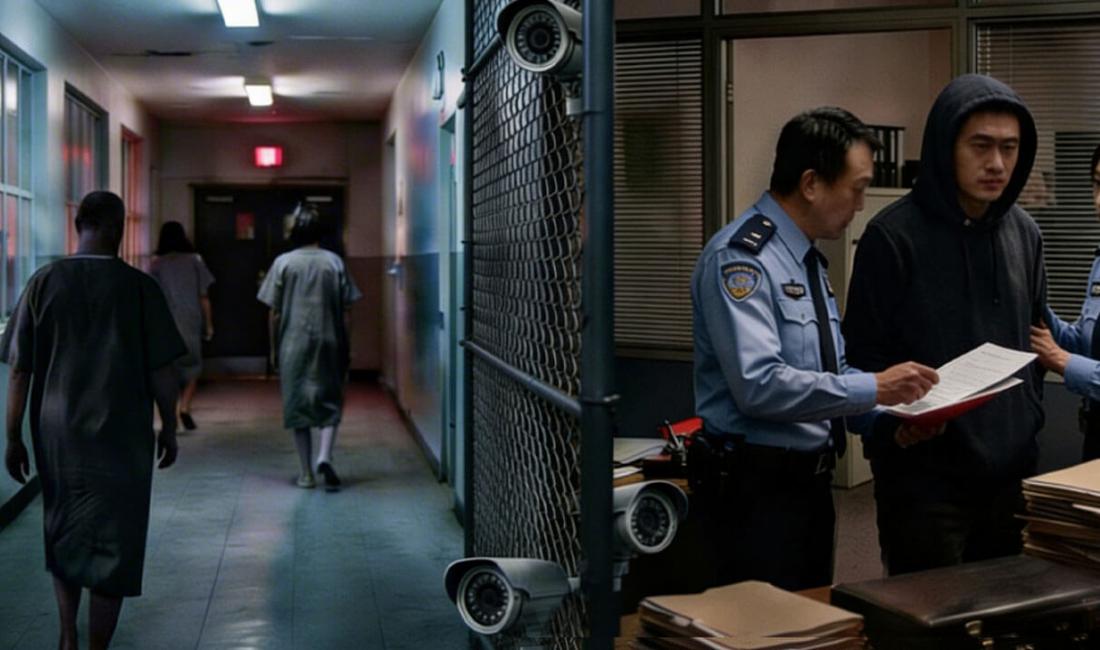
Insurance Scandal Spotlights How Chinese Authorities Detain Dissidents in Psychiatric Facilities
This series and lead image were produced and published by Asia Democracy Chronicles
First of Two Parts
It has been one of China’s most vile yet open secrets for decades, but up until recently the country’s authorities could not seem to be bothered to scrutinize it. And when they finally did start paying attention, the focus was narrow and excluded many other abuses happening in the system – as well as the flaws in the system itself.
By March 15, the provincial bureaus of China’s National Healthcare Security Administration (NHSA) are supposed to have completed their review of the psychiatric institutions under them; they have also been ordered to take appropriate action on any anomalies they find.
Insurance fraud being committed by various psychiatric institutions across China was uncovered by investigative media reports late last year and had led to a public outcry. The directive issued by NHSA in February was a response to that.
Last November, independent investigative journalist Wu Huaijun revealed that local governments across China were using the Ankang system not only to persecute their constituents. They were also using it to cheat the state financially by taking advantage of a special government policy for low-income individuals needing medical treatment.
(‘Ankang,’ which means “safe and health,” used to refer only to the country’s chain of state psychiatric hospitals meant for the criminally insane. But the term is now used to refer to the system of arbitrary detention of people in psychiatric hospitals without legal or medical basis.)
A few weeks later, a Beijing News report recounted how one of its journalists went undercover into two psychiatric hospitals in Hubei province and found more evidence supporting Wu’s findings. According to Beijing News, psychiatric hospitals were admitting individuals as having mental illnesses even when this was not true, and that many of these admissions were being done for “free,” because the hospitals used these “cases” to make claims from the state health insurance fund.
While some treatments were made up, many of the supposed patients were also made to take medicine and endure medical processes that they didn’t need. All these, including their stay at the psychiatric institutions, were charged to insurance.
“The hospitals treat the healthcare insurance fund as a cake to be taken and used as they please, converting patients’ health conditions into figures in their accounting books,” said the People’s Daily, the Chinese Communist Party’s (CCP) mouthpiece, in reaction to the report. “It’s not only a blatant defiance of the law but also tramples the bottom line of morality.”
Yet what the People’s Daily did not say – and authorities have not admitted – is that the practice of admitting people who are not mentally ill into China’s psychiatric hospitals is nothing new.
In fact, this has gone on for years, and has been used not just by these hospitals for financial gain, but also by local and central government authorities, including the police, as a means of public control.
‘Psychiatric prisons’
In 2022, the rights organization Safeguard Defenders published a report, “Drugged and Detained: China’s psychiatric prisons,” exposing the use of the Ankang system as an under-the-radar detention of people, among them political dissidents; some of whom were even forcibly confined many times.
The report examined cases from 2015 to 2021, and focused on 99 individuals who were incarcerated in psychiatric hospitals, their combined plight totaling 144 confinements and involving 109 hospitals across China. It stressed that there were many more people who were being forced into psychiatric hospitals and subjected to abuse, but that the system was so opaque that coming up with exact numbers was not possible.
The report garnered interest from international media and civil society, but was barely mentioned in Chinese media. Neither did it prompt any action from Chinese authorities – who apparently were still putting more perceived critics of the state in psychiatric facilities.
For instance, Wu Yanan was a young teacher at Nankai University in Tianjin until she was taken away by state actors some three years ago. For supporting students who took part in the so-called ‘White Paper’ protests during the COVID-19 lockdown, Wu was reportedly detained for a period of time at the psychiatric facility Tianjin Sheng’an Hospital. Her current condition and whereabouts are unknown.
Zhang Junjie, a former student at Beijing’s Central University of Finance and Economics (CUFE), was also forcibly detained in a psychiatric hospital on two separate occasions — at the end of November 2022 and January 2023 — for taking part in the ‘White Paper’ campaign and then in the “Fireworks Protests.”
Zhang was eventually able to escape and leave China; he now lives in New Zealand. In a 2023 interview with Radio Taiwan International, he said that the day after he turned 18, his family, who had colluded with the police, lured him to the hospital where he was then tied up.
“These three nurses and my grandfather told me that I was at the stage of schizophrenia,” he recounted of his first time to be supposedly brought under psychiatric care. “I said, ‘What is wrong?’ (Grandfather) said, ‘You do not support the CCP, you do not love the Party and the State, and you are mentally ill’.”
Zhang, who said that he was later beaten up and drugged, recalled being terrified “because I knew the CCP would lock up dissidents in psychiatric hospitals for persecution before, such as Dong Yaoqiong in Shanghai. But I really didn’t believe that this would happen to me.”
Dong Yaoqiong can be regarded as a classic example of China’s detention of dissidents in psychiatric facilities. In 2018, the then 29-year-old real estate agent based in Shanghai splashed black ink on a poster of Xi Jinping and posted a video of her act on Twitter. By that evening, Shanghai police had taken her away. Afterward, police from her hometown brought her to a psychiatric hospital there.
When she was released a year later, her father noticed changes in her, and could barely coax her to talk. He thought she was showing signs of dementia. Dong was returned to the psychiatric hospital in May 2020, but was released two months later. In December of that year, Dong uploaded what seems to be her last post on Twitter. In it she complained of being constantly monitored and of having lost all of her freedoms.
She ended by saying, “I won’t think about the consequences of tweeting tonight, I will take the consequences. I just want to ask, what did I do wrong? Have I violated the law?”
Dong was taken to another psychiatric hospital weeks later. She has not been seen since. The last known information is that she remains confined at the Third People’s Hospital in Zhuzhou, Hunan. Her mother and brother have been mum about her case since her father’s death; some of her other relatives believe she may have already passed away.
Family and financial gain
Dong and Zhang’s cases show how authorities use family members to justify their being brought to psychiatric facilities. In truth, one of the most ethically troubling aspects of the Ankang system under the Mental Health Law is the instrumentalization of family consent.
The law explicitly incorporates family members into decision-making processes, but these often occur under conditions of coercion or misinformation. Families may be pressured by police, community officials, or employers to consent to the hospitalization of one of their relatives in a psychiatric facility.
In other cases, families themselves seek institutional solutions to avoid internal conflict, social stigma, economic burden, or political risk.
This pattern recurs across cases. Take Cao Kexiong, a poet from Zigong, Sichuan Province, who had been administratively detained again and again for publishing poems critical of current affairs. In June 2024, he was committed to the Zigong Fifth People’s Hospital with the written consent of his parents, both state employees who were apparently loyal to the system.
The father of Zhang, meanwhile, was a village secretary. After he was released from the hospital for the first time, Zhang learned that his father had been dismissed from his post because of Zhang’s supposed misbehavior. This led to a big fight between father and son.
Days after, Zhang said, his father suddenly left the house with other family members, leaving him alone. Then the police came to the door and took him back to the psychiatric hospital again.
As for Dong, her father fought for her until he was arrested himself and thrown in jail, where he eventually died in 2022. Reports say that it was her mother who would help authorities get her committed into psychiatric hospitals; there were also unverified talks that her mother acquired a new home after her initial confinement.
Why local authorities go along with the hospitals’ claims about their patients can be explained in one word: money. When individuals are registered as patients with chronic mental illness, they are redefined as beneficiaries rather than rights holders, which make them eligible not only for medical insurance reimbursements, but also for local fiscal subsidies and, in some cases, poverty-relief programs.
This creates a financial logic that aligns hospital interests with local governance needs. Detention is thus not merely tolerated by local authorities; it is transformed into a chain of stable economic interests integrated with the social welfare system.
And so whenever a case of political psychiatric detention is exposed by the media, the investigation result announced by authorities – in response to the fervor of public criticism -- will always be that “this individual is indeed suffering from mental illness.”
Unsurprisingly, it becomes exceptionally difficult for victims to be released from the hospital. An individual who has been hospitalized at the Yiling Kangning Hospital for five years told the Beijing News journalist that “being hospitalized here is equivalent to being imprisoned,” and that out of sheer desperation, a fellow patient had committed suicide there last June. ◉