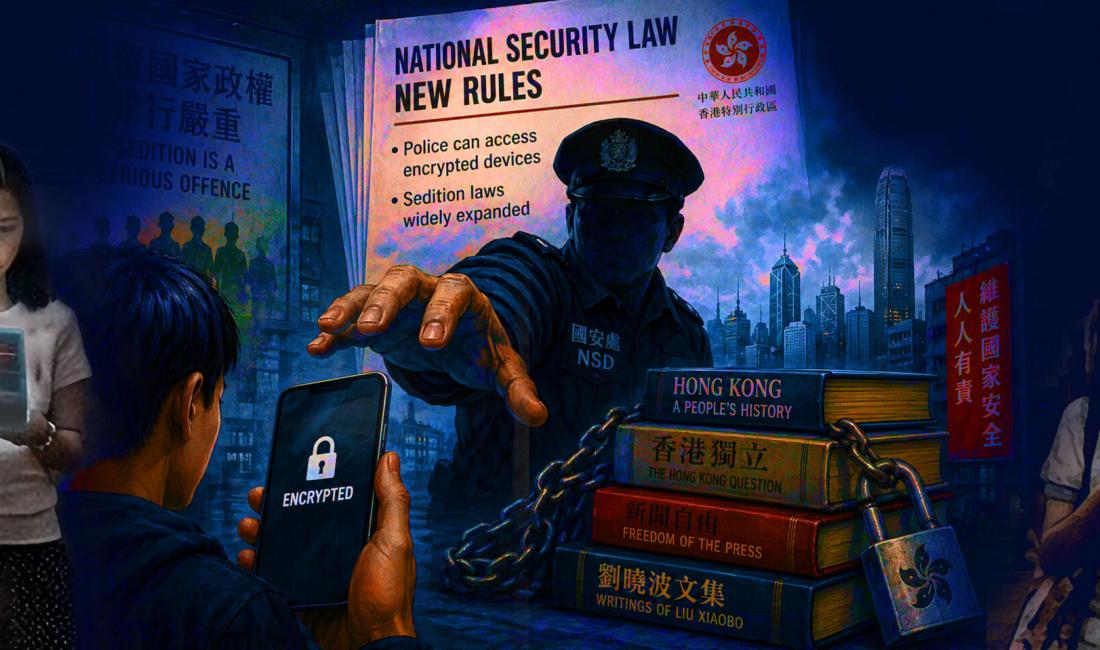
New national security rules expand police powers to access encrypted devices and widen the reach of sedition laws, signaling a sharper turn toward surveillance, censorship, and control over what residents read and store digitally.
This essay and image were originally published by Asia Democracy Chronicles.
Last month, Hong Kong quietly amended the implementing rules of the national security law (NSL), which now grants the police power – via court warrant – to compel anyone under investigation to surrender their device passwords or assist in decrypting electronics.
The scope is sweeping: it applies not only to the suspects, but to anyone believed to know the password, or anyone who owns, controls, or has previously used the device. Non-compliance carries a penalty of a HK$100,000 ($12,700) fine and up to one year in prison.
This significant change renders the NSL even more draconian than before. Since the law was imposed in 2020, the police have possessed far-reaching powers to summon individuals and require information under the law’s Article 43. In urgent situations, they can even search a premises for evidence without a warrant, provided they have the approval of an assistant police commissioner or higher.
Before the amendment, however, they had no explicit power to compel the handover of passwords or encryption methods. In a 2020 case (Sham Wing Kan v Commissioner of Police), the Court of Appeal of the High Court reconfirmed that refusing a police request to unlock a seized electronic device does not constitute the offense of “obstructing a police officer in the due execution of his duty.” While police could prosecute individuals for refusing to furnish information related to national security, refusing to provide passwords or assist with decryption was not a criminal offense.
This amendment sharply expands state access to individuals’ digital lives – from phones and emails to encrypted apps and cloud storage – and thus raises profound privacy and security concerns.
Eroding the right to silence
Jack Li, an activist using a pseudonym for security reasons, said this new power makes activists significantly more vulnerable: “In the past, we had a right to remain silent during interrogation. However, after the introduction of the NSL, we could be prosecuted if we refused to answer questions from the police. Now, it is even worse, as we could be imprisoned merely for not providing passwords, or even forgetting them.”
He also worries this will pave the way for police to further monitor activists. With courts rarely rejecting national security warrants, the safeguard appears largely procedural.
Notably, the government bypassed the legislature, amending the rules overnight despite having full pro-Beijing control of the Legislative Council. While passing a law would have been easy – the Safeguarding National Security Ordinance (also known as “Article 23”, the city’s second major national security legislation cleared in just 11 days – why didn’t the authorities simply put these amendments through the legislature to maintain the illusion that they were scrutinized and approved by the so-called “people’s representatives”?
Although no legislator would dare challenge the government during the legislative process, doing so would have invited scrutiny from businesses and rights groups, particularly over data privacy. Quiet rule changes avoided that. It is also evident that the government maintains an extremely high safety margin in its approach to legislative amendments, seeking to preempt even the smallest hint of opposition or criticism.
Other quiet changes
Less visible, but equally significant, are new powers wielded by Customs officers to seize items deemed to have “seditious intent” – even without an arrest. This builds on the broadened sedition law under the 2024 Safeguarding National Security Ordinance (SNSO), which criminalizes speech or publications deemed to incite “hatred” or “disaffection” toward authorities, without requiring proof of intent to cause disorder. Mere possession of “seditious” material carries a prison term of up to three years.
The broad and ambiguous definition of “sedition” remains one of the most controversial elements of Hong Kong’s NSL. In March 2024, the government further expanded the sedition law under the newly enacted SNSO. This criminalized any act, word, or publication intended to incite hatred, contempt, or disaffection toward the constitutional order or the executive, legislative, and judicial authorities of the HKSAR. Anyone who merely possesses a “seditious” publication, even without seditious intent and without displaying it publicly, faces up to three years in prison.
A defendant who is found to have committed an act with seditious intent faces up to 7 years in prison (escalating to 10 years if collusion with external forces is involved). Crucially, the SNSO does not require prosecutors to prove an intent to cause public disorder, making convictions significantly easier to secure.
In practice, sedition has become a “pocket crime.” Activists have been jailed for social media posts and even clothing with protest slogans. For instance, in May 2024, police arrested six people – including already-imprisoned activist Chow Hang Tung – for posting messages on social media ahead of the Tiananmen Square anniversary.
In September of that year, a man was sentenced to 14 months in jail for sedition simply for wearing a T-shirt bearing the words “Liberate Hong Kong, revolution of our times,” the primary slogan of the 2019 protests.
In a recent case on April 14, a 61-year-old man was sentenced to 12 months in prison for sedition after posting messages advocating Hong Kong independence on social media. Despite this, immediately following the passage of the SNSO, authorities had seldom used the updated sedition law to directly target bookstores or publications.
Booksellers in the crosshairs
Until recently, however, bookstores were not a primary target of the sedition law. Now, the newly granted powers for Customs and Excise officers send a strong signal that it may be changing.
Just one day after the Implementation Rules were amended, national security police arrested Pong Yat Ming, the owner of the independent bookstore Book Punch, along with three staff members, for allegedly selling “seditious” publications, including a biography of Jimmy Lai, the founder of Apple Daily, who was sentenced to 20 years in prison for collusion with foreign forces and sedition.
Pong’s bookstore has long faced scrutiny from the government. Like other independent bookshops, it has been subjected to repeated inspections and regulatory pressure. Recently, Pong was fined a total of HK$32,000 ($4,080) simply for hosting a 12-person Spanish language class at his store without registration.
More troubling is the law’s opacity. Authorities have never defined what constitutes a “seditious” publication or issued a banned list, even as hundreds of titles have quietly disappeared from libraries and schools. This weaponized ambiguity has triggered a severe chilling effect, forcing widespread self-censorship among the city’s remaining booksellers.
Ultimately, the newly expanded mandate for Customs and Excise officers strongly suggests they will now initiate targeted border spot-checks on imported books. Even after the implementation of the NSL, certain politically sensitive books could still be legally imported and sold in Hong Kong.
With officers empowered to seize materials on suspicion alone, that window may close. Both digital content and physical publications are subject to preemptive control.
Together, these changes mark a decisive expansion of Hong Kong’s national security regime: from compelling access to residents’ private digital lives to widening the definition and enforcement of “sedition.” By pairing new surveillance powers with looser controls over what counts as illegal expression, authorities are tightening their grip not only on what people say, but also on what they store, read, and circulate.