Food Estate Project in Indonesia Creates Uncertainty for Lives, Livelihoods, Culture
This article was published by Asia Democracy Chronicles. Image CC 4.0 via Wikimedia Commons.
Liborius Kodai Moiwend was at a local fishing port one sunny day last August when he chanced upon cargo ships unloading more than 300 heavy machines. He had no inkling he was watching the start of dramatic changes in the way he and the rest of his community live.
The elder in the Malind Indigenous community in Merauke, South Papua in Indonesia, Moiwend soon learned that the machines were excavators brought to clear forests and swamps that had sustained his people for generations.
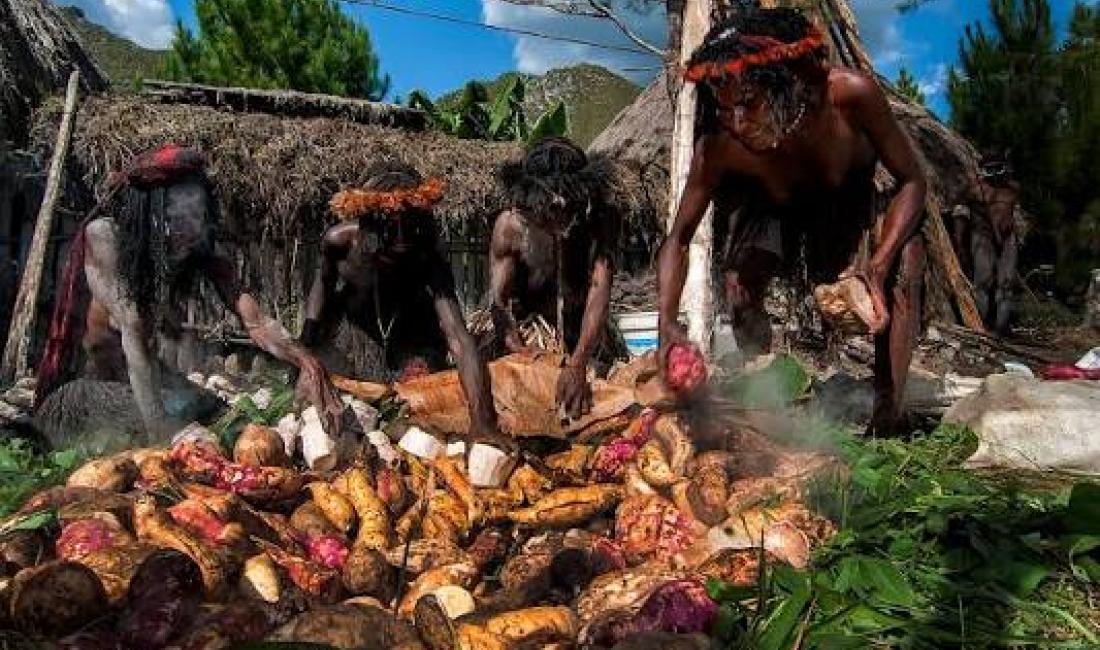
Like other Indigenous peoples across Indonesia, the Malind have relied on the forests not only as a source of food, but also as the foundation of their social and cultural life. Sago groves provide staple food. Rivers and wetlands supply fish and game. Sacred sites, burial grounds, and clan territories are woven into the landscape. To many Merauke residents, the forest is an inheritance linking past and future generations.
Officials of Indonesia’s central government, however, have had a far more varied view of the country’s forests. While they sometimes see value in the preservation of some forest areas, they consider many others as ripe for development.
In the case of Merauke, its forests have been marked as part of an ambitious National Strategic Project or PSN aimed at boosting Indonesia’s food and bioenergy production and reducing its dependence on imports. Initiated in 2023 during the administration of then President Joko Widodo, the Merauke National Strategic Project calls for the conversion of more than two million hectares of land in Merauke into rice fields and sugarcane plantations.
Government officials view Papua as an ideal location for the project because of its vast land area and relatively low population density. Much of the targeted area, however, overlaps with customary territories and ecosystems that Indigenous communities depend on for hunting, fishing, gathering, and small-scale farming.
The Indonesian government recognizes customary forests (hutan adat) or those used by Indigenous communities in their daily life for physical, spiritual, and cultural sustenance. But for a forest area to have this designation, a community must first claim it officially through a process described by many as a long and tedious bureaucratic nightmare. Between 2016 and 2025, only 400,000 hectares of customary forests were recognized by the government. The Alliance of Indigenous Communities (AMAN) maintains that Indonesia’s customary forests are at least 7.4 million hectares.
Permits from state
In a May 2025 letter addressed to U.N. Special Rapporteurs, Indonesian Deputy Permanent Representative to the U.N. Achsanul Habib said that the Merauke PSN “is situated within the Production Forest Area in South Papua Province, and to date, no request has been submitted by any party for the area in question to be classified as customary land.”
He also mentioned in particular PT Global Abadi, a participant in the project, as having secured the necessary documents and permits, and had even entered into a “partnership agreement” with local communities to “jointly manage a sugarcane plantation in some village areas.” Moiwend, though, had a somewhat different recollection of what transpired. While he did not go into specifics, he told Asia Democracy Chronicles (ADC), “The first time they came, they did not sit with us. They were like thieves.”
Other Indigenous groups and environmental organizations said that communities were inadequately consulted before large-scale land clearing began. Documents and testimonies collected by civil society organizations also indicate that many affected communities were never provided complete information about the project’s scale or potential impacts
Teddy Wakum of Papua Legal Aid said that in several villages, residents learned about development plans only after heavy equipment had already arrived. He added that the customary landowners have steadfastly defended their customary land and have repeatedly stated they will not relinquish it. “Yet,” Wakum said, “company officials continue to come. This constitutes intimidation, and the situation is exacerbated by recent land grabs.” Several rights groups have documented thousands of hectares of land-grabbing cases over the course of the project rollout, leading to loss of control over ancestral land.
According to Yayasan Pusaka Bentala, a nonprofit with a focus on Papua, 38 companies obtained control of more than 1.5 million hectares of land under the Merauke PSN without public participation in the process. “All were carried without the consent of indigenous communities,” said Yayasan Pusaka Bentala director Franky Samperante.
Food security and project fails
For decades, Indonesia has struggled to meet domestic sugar demand. Annual sugar production stands at around 2.67 million tons, less than half of the 6.33 million tons consumed nationwide. The shortfall has forced Indonesia to import nearly four million tons of sugar every year, making it one of the world’s largest sugar importers.
The Merauke PSN is expected to narrow that gap. Officials estimate the food estate could produce between two and three million tons of sugar annually, turning South Papua into one of Indonesia’s largest sugar-producing regions.
Food security concerns have been a major political priority since the inception of the New Order regime in the 1960s, and later exacerbated by the COVID-19 pandemic, climate crisis, and geopolitical conflicts. In 1996, the Soeharto administration initiated the Mega Rice Project in Kalimantan, turning one million hectares of ancient peat swamp forest into rice fields. The project failed due to soil characteristics and lack of infrastructure. It also became infamous for being among the worst ecological disasters in modern history; converting peatland released billions of tons of carbon into the atmosphere that for decades since have caused frequent wildfires, which experts called “carbon bombs.”
Rice, an Indonesian staple, is still a source of concern for policymakers. Imports rose from around 305,000 tons in 2017 to 4.5 million tons in 2024, according to government data. Meanwhile, domestic production has remained relatively stagnant at around 30 million tons annually during the same period, leaving little margin for supply shocks in a country of more than 280 million people.
For the government, Merauke represents an opportunity to address these vulnerabilities at scale. Yet critics of the Merauke PSN say that Jakarta has ignored not only the rights of local residents, especially the Indigenous peoples, but also research indicating that the regency may not be the right place for the project.
Much of the land targeted for the PSN consists of peat swamp forests, wetlands, and seasonally inundated landscapes that require extensive modification before they can be converted into industrial farmland. Researchers and environmental groups have long warned that the ecological characteristics of southern Papua present significant challenges for large-scale rice cultivation.
A study by Indonesia’s own agricultural land research agency noted that many areas in Merauke are dominated by swampy soils and complex hydrological systems, requiring intensive water management, soil treatment, and continuous intervention to maintain agricultural productivity. High soil acidity and poor nutrient content have also been identified as major constraints for rice development.
Even government officials have acknowledged these challenges. In 2023, Presidential Staff Office chief Moeldoko said that high iron content in Merauke’s soil had affected fertility levels and disrupted rice cultivation in parts of the food estate area. “The plant turns yellow and the soil is not very fertile,” Moeldoko said, acknowledging the challenges facing the project.
Poor planning?
Environmental organizations argue that these limitations raise broader questions about whether industrial rice cultivation is being imposed on a landscape historically shaped by different ecological conditions and food systems.
In a 2021 paper, the environmental group WALHI Papua noted that food-estate planning in Papua largely prioritizes commodities such as rice and sugarcane while overlooking local food sources traditionally consumed by Indigenous communities.
The organization has warned that the project risks repeating earlier large-scale agricultural programs in Merauke that failed to achieve their intended goals while accelerating deforestation and social conflict. Said WALHI Papua: “This program will put humans and other entities at risk of ecological disaster and climate change.”
Critics also point to the region’s long history of abandoned food estate projects. Merauke has been targeted repeatedly as a future food barn through initiatives such as the Merauke Integrated Rice Estate (MIRE) and the Merauke Integrated Food and Energy Estate (MIFEE), many of which struggled to meet production expectations or were eventually scaled back. (The Merauke PSN is considered as a pumped up version of the stalled MIFEE, an initiative of the Yudhoyono administration.)
For environmental groups, the central concern is not merely whether rice can be grown in Merauke, but whether the conversion of millions of hectares of forests and wetlands into industrial plantations represents the most viable response to Indonesia’s food security challenges.
Lola Abas, national coordinator of the environmental nonprofit Pantau Gambut, asserted that Papua’s soil is not suitable to be converted into plantations and farmlands, and that draining up peatland will cause catastrophic impacts. She also argued that Indonesia’s food vulnerabilities are often linked not only to production shortages, but also to problems in distribution, infrastructure, and market access.
“The problem lies in distribution and agricultural marketing, not availability,” said Abas, warning that the food-estate program risks repeating the failures of previous large-scale agricultural projects.
Wailing in the wind
Complaints regarding the Merauke PSN are among the 114 complaints the National Commission on Human Rights said it received from communities affected by national strategic projects across Indonesia between 2020 and 2024. Not one of those complaints has led to tangible results so far.
In Merauke itself, residents have staged protests on multiple occasions, including attempts to block roads and prevent workers from entering their community’s forests. Several demonstrations were dispersed by security personnel assigned to guard project sites. Community leaders described an atmosphere of fear and intimidation as military and police officers became a visible presence around areas slated for development.
At the United for Wildlife Global Summit in Brazil in November 2025, Indonesian Forestry Minister Raja Juli Antoni announced that President Prabowo Subianto had set the target of recognizing 1.4 million hectares as customary forests by 2029. The state-run Antara news agency has since reported that the government is fast-tracking the designation process, with 368,877 hectares declared as customary forest as of end-April.
Antara also quoted Soeryo Adiwibowo, head of the Task Force for the Acceleration of Customary Forest Status Designation, as saying, “In 2026, an additional 12 units covering 14,269 hectares have been designated from ongoing proposals.” It is unlikely that any of these are located in Merauke, however.
Within months after the excavators arrived, residents reported hearing chainsaws and heavy machinery operating day and night. Forests that once served as hunting grounds were cut open by access roads. Wetlands were drained and cleared. Community members said that they were often left uncertain about which areas would be affected next, and whether the land being cleared had already been allocated to companies or government projects.
“They destroyed the forest while being guarded by the military,” Moiwend said. “We cannot do anything. Swamp and forest were destroyed by this project.”
He added: “When the forest disappears, we lose more than trees. We lose the place where we find food, where we teach our children, and where our ancestors remain with us.”
Adi Renaldi is a Jakarta-based freelance journalist. He was a staff writer at VICE Indonesia for four years, where he produced long-form journalism on topics including culture, the environment, and religious extremism. His byline has also appeared in New Naratif, Mongabay, and Coconuts.