Hong Kong's Deadliest Fire in Decades Exposed Corruption—and Civil Society's Resilience
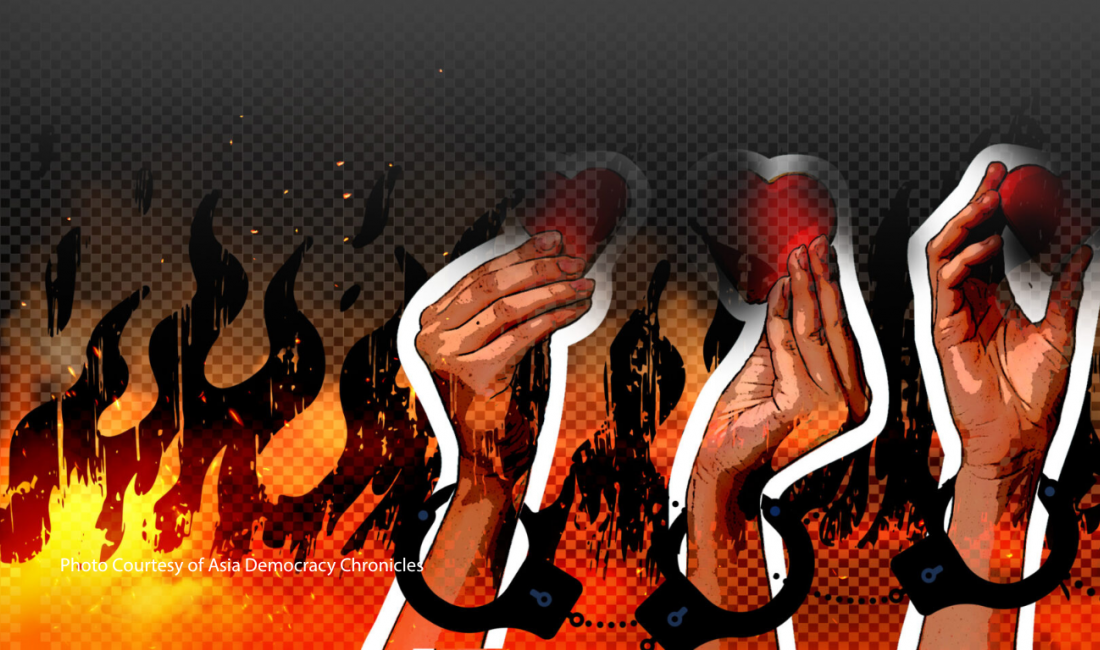
This essay and the lead image were produced and published by Asia Democracy Chronicles.
Like other bustling metropolises, Hong Kong sees millions commute daily between the city center and their homes. For residents of Tai Po, a district in the city’s New Territories, the sight of eight distinctive high-rise buildings near the Tolo Highway serves as a landmark:
after a long day of work and a bus ride, they know they are almost home. Similarly, visitors know it is almost time to disembark when they spot these apartments.
No one could have imagined that the unassuming cluster of residential flats known as Wang Fuk Court might one day suffer devastation that would claim so many lives.
Weeks after the blaze that left at least 160 people dead and dozens injured, there is still no clue on how it started.
Most witnesses say the fire began in the early afternoon of Nov. 26. It would rage on for more than 40 hours. By the time it was under control, seven of the complex’s eight 31-floor buildings, with nearly 2,000 households, had been incinerated.
The idea that so many people could perish in a fire in Hong Kong—a city accustomed to rigorous safety standards—seemed inconceivable. Consequently, many suspect this was no mere accident, but the result of a systemic failure. This is why, when the government and international media outlets ranging from CNN to Al Jazeera pointed the finger at the bamboo scaffolding used by the contractor doing repair and renovation work on the complex, the public was furious.
Firstly, bamboo scaffolding has been used for generations in Hong Kong and rarely causes such rapid fire spread; there is no evidence suggesting it was the primary accelerant. Secondly, this narrative shifted focus away from more likely culprits. Many residents, for instance, reported that fire alarms failed to work. Another crucial detail was that the windows had been covered by netting and Styrofoam by the contractor, and many residents did not notice the blaze until it was too late to escape. Investigations later revealed that these materials were highly flammable and did not meet safety requirements.
The issues go deeper than netting and Styrofoam, however. The public understands that behind the flames lies a failed policy that facilitates the transfer of benefits and corruption. Unfortunately, today’s Hong Kong lacks the checks and balances that in the past could have addressed that flaw, and also would have allowed the assertion that even those in power bear more than some responsibility for the tragedy.
Hours into the blaze, netizens had unearthed past social-media posts in which Wang Fuk Court residents had complained about the construction company stockpiling flammable materials inside the building. More recently, it has been revealed that residents had even filed complaints with numerous state agencies – including the Independent Commission Against Corruption (ICAC) –about the renovation work. These complaints apparently prompted government visits to Wang Fuk Court, the latest of which, according to a report by Hong Kong Free Press, was just a week before the fire.
Rigged bids
Allegations have also surfaced that the company doing the renovation work was hired through bid-rigging—a corrupt practice frequently plaguing old buildings under mandatory inspection orders.
Mandatory building inspection and renovation have burdened Hong Kong property owners for over a decade. The policy can be traced back to 2003, when the government conducted a public consultation on the growing problem of Hong Kong’s aging infrastructure. In 2009, to create jobs following the financial crisis, the government launched “Operation Building Bright,” a voluntary scheme subsidizing repairs. By 2011, this had become mandatory for buildings aged 30 years or older. With many apartments built between the 1970s and 1990s, over 2,000 buildings have since been selected yearly for mandatory inspection.
Since its implementation, the mandatory inspection scheme has become a gold mine for unscrupulous construction companies and criminal syndicates that monopolize the bidding process. Before tendering begins, these groups secretly collude to decide the winner. Other companies submit intentionally inflated bids to create an illusion of competition while driving up the final price. When owners raise concerns about bid-rigging or exorbitant fees, they often face threats or assaults by triad members. In some estates, these companies collude with owners’ corporations—some of whom are active members of pro-government parties—to orchestrate the process.
After winning a bid, these firms often subcontract the work at much lower prices. To maintain profit margins, subcontractors cut corners, using substandard materials or delivering shoddy workmanship. Consequently, despite paying substantial sums, property owners often face additional costs to rectify faulty work. The contract for the Wang Funk Court renovation was reportedly HKD 330 million ($42.4 million).
The Wang Fuk Court fire thus resonates with many property owners who have suffered from bid-rigging and graft. Yet there are no longer any pro-democracy lawmakers and district councilors who would actively pursue bid-rigging cases. These figures are now barred from office under Hong Kong’s “patriots only” legislation.
While they watched the flames furiously make their way through the apartments, many Hong Kongers probably thought of Lam Cheuk-ting. A former legislator and prominent figure in the anti-bid-rigging movement, Lam had successfully helped numerous owners fight back against extortionate renovation costs. The danger of his work was real:
he once told the press he wore a large backpack specifically to shield his back from triad attacks.
Lam, though, has been imprisoned since February 2021. One of the ‘Hong Kong 47’ pro-democracy activists who were arrested in the city’s largest national security case yet, he was convicted of several charges and is not expected to be released until at least 2030.
Community and crackdown
Public anger has been palpable following the fire, but that may not be the government’s only concern. As firefighters battled the flames that kept consuming floor after floor, flat after flat, people on the ground spontaneously mobilized to bring food, water, and aid to Tai Po. With no central organization, they coordinated delivery and distribution solely through social media and on-the-ground cooperation. Volunteers formed human chains to move goods, and local businesses offered free meals to those who the blaze had rendered homeless.
But this decentralized, citizen-led support—reminiscent of the civic spirit seen during Hong Kong’s past protests— caught the attention of the authorities. In other nations, a civil society showing such resilience and mobile relief capabilities would be seen as an asset. In Hong Kong, such an autonomous and energetic civil society is viewed with suspicion by the authorities.
Instead of applauding community efforts to aid survivors of the fire, Hong Kong authorities somehow saw a spectre that they apparently believed was a national security threat. The volunteers were told that the government was taking over the task of helping the fire victims. The city’s current officials also began rebutting criticism by accusing people raising questions and demanding justice of “using the disaster to stir up chaos, “disseminating fake news and false messages,” and “sowing discord.”
Just days after the last flame at the complex was finally put out, national security police arrested a university student for sedition; he had distributed flyers promoting an online petition that called for an independent investigation and official accountability. On Dec. 2, a group including activists, a solicitor, and a town planner were taken away by police while preparing for a “civil society press conference” regarding the fire and building maintenance policy. The conference itself was canceled. One of the scheduled speakers, veteran political commentator Wong Kwok-ngon (also known as ‘Wong On-yin’), was later revealed to have been arrested and charged with sedition and divulging details of national security enquiries.
This new wave of arrests has drawn international attention to the deteriorating human rights situation in Hong Kong. Volker Türk, the U.N. High Commissioner for Human Rights, has expressed deep concern regarding the arrests and called for the charges to be dropped.
Today, many in Hong Kong remain in mourning, hoping the truth will finally come to light and that those responsible will be held accountable.
Corruption and bid-rigging could be eliminated through systematic reform. The pursuit of justice, however, will be immensely arduous and fraught with obstacles. As of this writing, more than a dozen people have been arrested in connection with the blaze, including engineers, contractors, and former and current officials of the building owners’ corporation. But no official has taken any responsibility for the fire yet. The Hong Kong government has established a committee to probe the blaze, but its independence remains highly questionable, as all members are government loyalists.
Unlike the independent commission of inquiry demanded by the public, this committee lacks the statutory power to summon witnesses or compel evidence.
That said, this blaze has, strange as it may seem, rekindled a deep affection for Hong Kong in the hearts of many, particularly due to the avoidable wrongs lying at its source. The sight of the charred remains of seven high-rises that used to house families will serve as a painful reminder not only of the tragedy, but also of the injustices behind it – as well as of a city that once would have tried its best not to have it happen.