Fish, Debt, and Dangerous Seas Cause Crisis in Coastal Communities
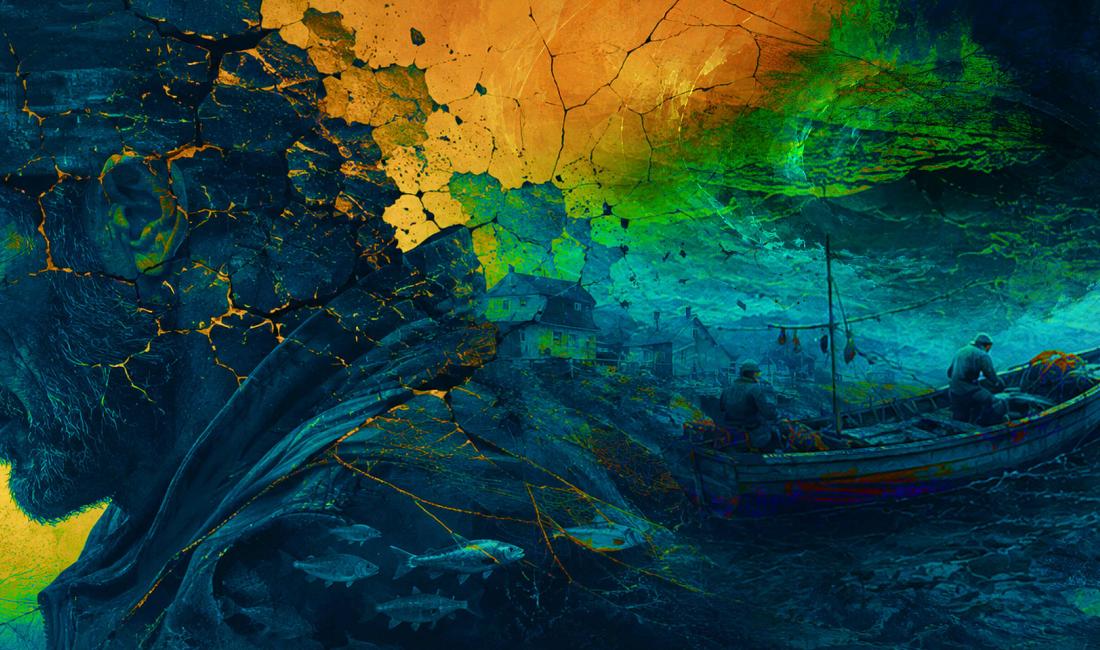
This story and lead image are published by Asia Democracy Chronicles.
Since he was 15 years old, Sreenu K has been going out to sea to catch fish twice a month, for about 10 to 12 days each time. Starting out as a helper to learn the trade, he is now, at 26, a senior fisher.
Yet while his expertise has grown, his catch has declined. The fish stocks are thinning, and the time and distance Sreenu must travel to have a fairly decent haul are increasing each year. For all that effort, the return is meager for him and the usually nine other fishers with him on a rented boat. After 10 days at sea, each one will earn only around $110.
“We have no idea why the fish are disappearing,” says Sreenu, “but it is giving us sleepless nights.”
Just recently, he returned to Vizag port in India’s southeastern state of Andhra Pradesh after yet another disappointing fishing trip. He now often wonders if he can ever afford to marry. According to Sreenu, most of his coworkers are looking to quit fishing altogether. But with no other skills, they often turn to heavy drinking to escape – at least for a few hours – their dismal circumstances.
“We don’t know how to do any other work, and don’t want our children to grow up and have nothing,” says Sreenu. “We don’t want them in this profession.”
Sreenu himself finds solace in the endless days of quiet at sea, where he likes bundling up on the hood of the boat, watching the stars or spotting a dolphin on a moonlit night. But the stress brought on by a livelihood that is no longer putting enough food on the table never really goes away.
And while Sreenu appears to be handling matters as best he can, they have become too much of a burden to bear for far too many fishers.
About 25 kilometers up the coast, a fishing community is quietly going through a mental health crisis. According to health workers at Bheemunipatnam village, there has been a rise in cases of alcoholism and domestic violence there, as well as in suicide attempts, in the last five years. Health workers believe all these are linked to mounting mental stress, with fish becoming scarce and the sea turning more dangerous, especially for those who have to rely on it to survive.
For years now, researchers and rights advocates have been linking climate change-induced economic hardship to a significant number of India’s suicide cases – which now account for nearly a third of the global total — particularly those occurring in the agricultural sector. Peer-reviewed research has documented the link between climate change and suicide attempts, with rising temperatures linked to an additional 4,000 suicides in India, accumulating to over 59,000 suicides over the last three decades. The Sixth Assessment report of the Intergovernmental Panel on Climate Change (IPCC) itself pointed out that climate change has already harmed mental health worldwide, particularly through extreme weather events, displacement, and related socioeconomic pressures.
Research also shows that climate change can increase substance abuse and alcoholism. Yet research on the mental-health burden specific to fishing communities, one of the world’s most climate-exposed populations, remains sparse. In Andhra Pradesh – India’s top marine-product exporter – the annual suicide count rose from 6,101 to 8,908 between 2014 and 2022.
In Bheemunipatnam, 10 people died among the many who tried to take their own life there between January and June last year. By the end of 2025, that number had reached 27; of these, 23 were men in the age group of 23 to 45. In 2024, 25 people died by suicide in the region, according to the community health center (CHC) records – 15 of them men in the same age group.
“These are high numbers for a population of about 250,000 that this hospital caters to,” says Dr. Phani Kumar, medical superintendent of the Bheemunipatnam CHC, which serves about 30 settlements and villages. “We have seen this surge in the last four to five years, and especially among young men. There has been a simultaneous increase in the domestic violence and alcoholism cases as we receive at least two to three cases in our outpatient department every day – some of them severe enough to be hospitalized.”
Mylapalli Sravanthi does not mention being abused in any way by her late husband, who was a fisher. She does say, though, that after he started accumulating debt, mainly to pay for rent and for the schooling of their children, he took to the bottle.
Apparently, the interest on the loans was compounding faster than any fishing trip could cover, and he had become desperate. He died at age 45 last year, by suicide. Sravanthi has been left with a debt of INR 500,000 (about $5,000) that she will have to find ways to pay, while supporting two teenage children who have yet to finish high school.
Mental-health experts and researchers emphasize that suicide is a complex event and can have multiple contributing factors. Still, Lennart Reifels, a Principal Research Fellow in Mental Health at the Melbourne School of Population and Global Health, has noted that extreme climatic events increasingly affect communities around the globe, with the potential to dramatically alter the natural, built, and social environments and threaten the livelihoods that communities depend upon.
Reifels, co-chair of the Climate Change and Suicidality Special Interest Group at the International Association for Suicide Prevention, told Asia Democracy Chronicles (ADC) that the risk of adverse mental health impacts is heightened and sustained in settings where livelihoods are threatened by environmental shifts.
A group of academics meanwhile said in a comment published last year by Nature Medicine: “Very slow-moving hazards, such as displacement due to rising sea levels, and altered landscapes and weather patterns are even more difficult to conclusively link to suicidal behaviors owing to the temporal decoupling of exposure and outcome and uncertain causal pathways.”
“Nevertheless,” they continued, “a handful of mostly qualitative studies have linked these environmental changes with feelings of loss, sadness and grief, especially for people living in rural, agricultural, and indigenous communities who depend on the land for their livelihoods. Lost livelihoods, forced displacement, and disrupted social support networks are psychologically distressing and plausibly elevate direct and indirect risks for suicidal behaviors.”
Seas of trouble
For sure, overfishing and pollution are among the major factors adversely affecting marine life – and consequently the livelihood of India’s fisherfolk. But the impact of climate change on bodies of water across the globe has also been profound, with the IPCC Sixth Assessment Report listing more frequent marine heatwaves, rising sea levels, and deoxygenation among the results. These in turn have been leading to disruptions in fish migration patterns and shifts in fish distribution, if not to fish population decline, among other things.
Then there are the cyclones, which have become a recurring serious problem particularly since 2019, when the Extremely Severe Cyclonic Storm Fani hit eastern India and Bangladesh. Aside from forcing fishing activities to be suspended repeatedly, the devastation such cyclones have wrought especially to coastal communities has made life even harder there and has caused psychological distress
“Things have been pretty bad the last few years,” says Mahesh Umidi, who decided to become a full-time fisher six months ago following the death of his father. The 21-year-old had been pursuing a general arts degree at university, hoping it would help him land an office job later; he had noticed that fishing had become less and less lucrative. But he quit college to take over his father’s breadwinner role in their now family of five.
A small-time fisher who survives on his day-to-day earnings, Umidi can only remain between 30 and 50 nautical miles from coast whenever he makes his maximum daily trips of two to the sea. He does the first in the wee hours with some other fishers and helpers and returns by 8 and 9 a.m. with whatever they catch for the morning market. More and more, though, the morning catch is not satisfactory, and he goes out to sea again in the early afternoon.
The economics are punishing. A single short trip can cost around INR 2,000 ($20.7) in fuel. On a typical day, Umidi shares the catch with four other fishers; after fuel costs are deducted, they are left with just a few hundred rupees each. With new boats costing between INR 400,000 and INR 500,000 ($4,150 to $5,178) and requiring replacement every few years, the debt cycle is inescapable.
“People are under stress and some have even attempted suicide,” says Umidi. He says that in the past, one trip was enough for them to have a good catch. Now, he says, despite making two trips to the sea, they are still earning less, “getting into deeper debt as the cost of fuel, nets, and daily essentials keeps rising.”
The resulting stress and sleep deprivation have led to a surge in health issues among women fishers as well, according to health workers. Studies have shown that to begin with, many of the women already suffer from anemia, malnutrition, and kidney problems.
Danny Shankar, a community leader in Vizag, says that over 800 women fishers in the area have been forced to seek work as domestic help in nearby cities, many joining the National Domestic Workers’ collective as household income from fishing continues to decline. Shankar says that his own three sons have left fishing entirely for corporate jobs and running a restaurant.
A veteran fisher whose family has fished local waters for generations, Shankar has been observing the dramatic ecological shift with dismay.
Fish like mackerel, ribbon fish, and black and white pomfret were once common, he says. But now they are rarely seen.
“We used to identify the season by what was running,” adds Shankar. “Now there is no season.”
The reporting for this story was made possible by the Medecins Sans Frontieres (MSF) Without Borders Media Fellowship. MSF, also known as Doctors Without Borders, works with journalists to encourage independent, impartial, and neutral reporting on health and humanitarian crises.