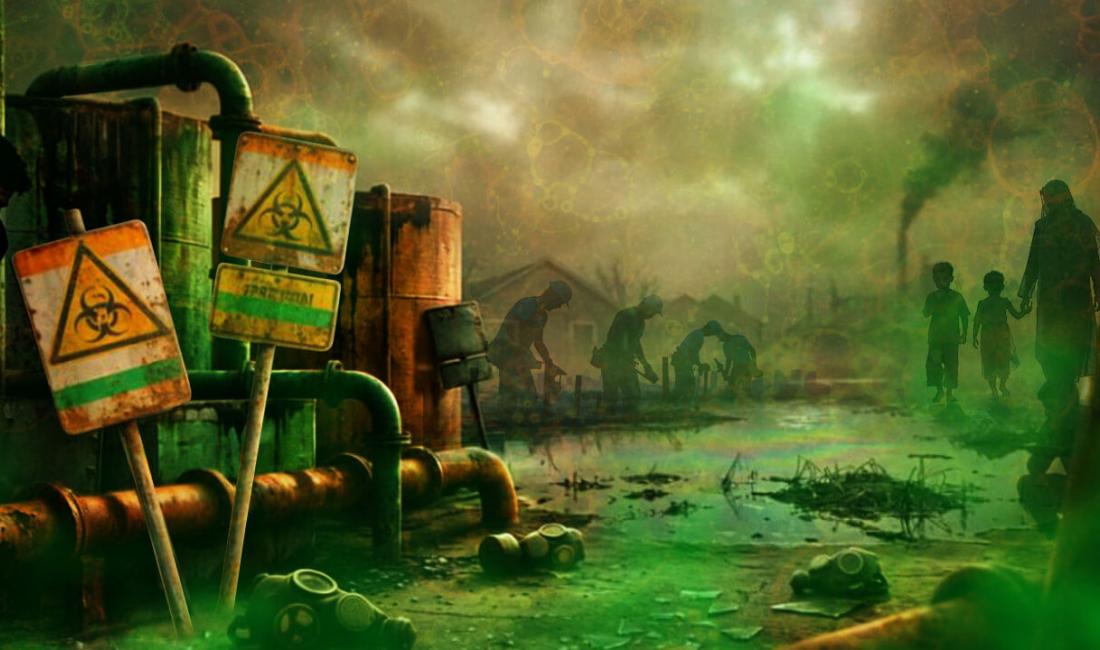
40 Years After Union Carbide Caused Thousands of Death, Facility Still Poses Health Risks
This special report and the lead image are produced and published by Asia Democracy Chronicles
If the government of the Indian state of Madhya Pradesh could have its way – and chances are, it will – a spanking new memorial will rise at ground zero of what is still known as the world’s worst chemical disaster.
During a visit to the abandoned Union Carbide factory complex in Bhopal in mid-January, Madhya Pradesh Chief Minister Mohan Yadav announced the revival of the plan for the memorial, which had been mothballed for years.
“The chemical waste lay there for nearly 40 years,” media reports quoted Yadav as saying: “Under the guidance of the High Court, our government successfully disposed of the chemical waste without any environmental damage or human loss. Taking all sections of society and affected stakeholders into confidence, and under the guidance of the High Court, we will now proceed to build a memorial for those who died in the Bhopal gas tragedy on these now-cleaned premises.”
Environmental and rights activists, however, take issue with Yadav’s claim that the government has “successfully disposed of the chemical waste.” Survivors of this 1984 tragedy would also probably prefer that the money allotted for the memorial be used for treatment of the ailments that they still suffer because of the gas leak more than four decades ago.
Indeed, the Bhopal disaster is far from being over, despite what Madhya Pradesh officials apparently want to believe. Tons of toxic waste that were transported last year from the Bhopal plant to an incinerator in Pithampur, some 220 kilometers away, are now ashes, but are still in storage there, waiting to be brought to their next destination.
Initial plans to bury it onsite, close to homes, were struck down by the High Court in October 2025 as “unacceptable.” Judges mandated a remote alternative, distant from people, farmland, and water sources, but there has yet to be a decision where that should be.
This has left Pithampur residents increasingly worried over the still toxic pile in their midst, while people elsewhere in India are hoping that their town or city will not become its next unwilling host. The concern stems in part from the perception that Indian authorities pay little heed to what the public wants or needs, unless elections are near.
Chronic problems
The bigger reason, though, is that India’s record on managing incinerator waste remains mixed, with rapid expansion in facilities overshadowed by persistent issues of poor enforcement, frequent emissions violations, and inadequate handling of the resulting ash.
And this is no ordinary pile of ash. It is what is left of more than 300 tons of contaminated waste gathered above ground at the Union Carbide India Limited pesticide plant in Bhopal, where poisonous chemicals were apparently dumped around the premises for years, with little safety protocols.
On the night of Dec. 2-3, 1984, a tank leaked 42 tons of methyl isocyanate gas, enveloping its surroundings with a toxic cloud. The company’s own official count was 3,828 deaths immediately after the disaster, but the total number of fatalities related to the incident climbed to as many as 20,000 over the years. Half a million survivors were left scarred, battling respiratory ailments, blindness, and physical and mental trauma.
Environmental scientist and Indian Institute of Technology (IIT)-Hyderabad professor Asif Qureshi thus calls for caution in the disposal of the ashes and advises against any hasty burial. “Landfill quality, maintenance, floods – all factors matter,” he says.
“Any landfill waste leaches sooner or later,” activist Rachna Dhingra of the Bhopal Group for Information and Action comments. “Pithampur’s existing landfill already pollutes water and the pollution board issued notices.” She draws parallels to past blunders, pointing out: “The Union Carbide ‘pond’ was a landfill, too, and it leached.”
Retired scientist Dr. Babu Rao Kalapala, a vocal activist with Scientists for People, states: “All landfills eventually leak. It’s a well-established fact. Even with advanced containment, failure over time is possible. Unless the incineration destroys nearly all hazardous compounds, there is a real long-term risk of soil and groundwater contamination. Toxic residues like heavy metals and dioxins can slowly leach out over decades, making permanent monitoring essential.”
Spotty record
Of India’s approximately 62 million tons of municipal solid waste generated annually, only a small fraction – roughly 2 to 5 percent, focused on biomedical and other hazardous materials – ends up in incinerators. Incineration reduces waste volume by 90 to 95 percent, destroys pathogens, generates energy, and requires less land than landfills. But it produces emissions such as dioxins, furans, metals (including lead and mercury), and acidic gases, among other things, as well as demands specialized ash handling.
Many incinerators in India, though, lack essential scrubbers or real-time monitoring, leading to improper ash disposal. There are supposedly dedicated pits for bottom ash, hazardous waste sites for the more toxic fly ash, or engineered dumps in places like Delhi. In medical waste cases, ashes may be placed in trenches covered with lime.
Unregulated practices persist, however, and include open dumping or mixing ash into construction materials, which heightens risks of toxic leaching into soil and water sources. The Canada-based nonprofit Wilderness Committee asserts that lime that acts as anti-leaching shield for incinerator ash in some set-ups is eventually washed away by rain. It points out as well that “in ash form, the toxins are more liable to leach than if they are in unburned waste.”
Dhingra argues that containment was the wiser path. “If they didn’t have the courage to send it to America, they could have left it sealed in the containers,” she says. “Then it wouldn’t have seeped into the ground or spread through the air. But by burning it, they completely exposed people in the surrounding areas, and now it has tripled.” By “tripled,” Dhingra is referring to the 900 tons of ash produced from the 300 or so tons of waste trucked from the Union Carbide plant in Bhopal.
Interestingly, shortly after trial runs on Bhopal waste began in February last year at the Pithampur incinerating facility, complaints of recurring fevers, sore throats, and eye irritation started as well in Tarpura village, less than 500 meters.
Asia Democracy Chronicles (ADC), however, has been unable to ascertain whether or not similar health complaints were already being recorded even before the trials. Over a decade old, the facility has been used for years to burn industrial waste in the region.
There had been earlier trial runs to see if the facility could handle the Bhopal toxic waste: twice for non-hazardous materials (2010 and 2012) and once – in 2015 – to burn some 10 metric tons of waste from Bhopal. While there were no major documented failures, locals remained fearful of possible poisonous emissions and contamination.
Pithampur was selected as the incineration site for the Union Carbide waste primarily because it hosts Madhya Pradesh’s only Treatment, Storage, and Disposal Facility, which has an incinerator capable of handling hazardous waste. A 2007 attempt to use a similar facility in Ankleshwar, Gujarat (about 500 km from Bhopal) was blocked by local authorities there. Three years later, the Supreme Court designated Pithampur as the most suitable location (affirmed in 2012) for the toxic waste, given that it is closer to Bhopal and is part of Madhya Pradesh.
Pithampur residents protested against the move. Hemant Shirole, a 55-year-old leader of the grassroots group Pithampur Bachao Samiti, tells ADC: “The government clearly promised back then that no waste would come here. Even Sushma Swaraj, then opposition leader from the Bharatiya Janata Party (BJP), protested against polluting Dhar and Pithampur.”
Pushing through protests
The BJP now holds power both in Madhya Pradesh and at the national level. Yet that made no difference to the decision to have the Bhopal waste incinerated at Pithampur. The Samiti mobilized massive protests. For months, angry crowds gathered. Tensions escalated, stones were hurled, and desperate self-immolation attempts occurred.B
But to no avail. Trial burns kicked off in late February-March last year, with Shirole accusing officials of doctoring results – “hiding facts” – to secure approval from the Madhya Pradesh High Court. The full incineration followed in March-April to June 2025, with emissions monitored online.
Residents remain deeply skeptical of the data’s accuracy, and their misgivings may have basis. Qureshi, who specializes in mercury and toxic pollutants, reports inconsistencies in the trial data. “Mercury must come out in air, ash or waste,” he explains. “But mass balance doesn’t match, something is missing.”
He says figures from earlier Central Pollution Control Board (CPCB) reports clashed with newer data from the Madhya Pradesh Pollution Control Board (MPPCB), violating basic mass conservation rules. “This suggests something is amiss,” Qureshi says.
He ponders if the mercury documented by CPCB had already vanished before trials, then wonders aloud, “If there was no mercury in the waste, what was the need to burn it and produce more waste? So, the question is: which of the above scenarios is the reality?”
From just 10-ton trials, Qureshi estimates 1.53-6.88 kg of mercury was released into the air. Scaled to the full load, that could mean 40-200 kg of the deadly neurotoxin dispersed. Officials only added real-time mercury monitors for the main burns last May, insisting levels remained safe.
The MPPCB has also upheld its oversight. An August 2025 report, presented in court, showed mercury on the lower end compared to joint CPCB and National Environmental Engineering Research Institute (NEERI) assessments, concluding emissions stayed within limits.
The board pushed for dedicated mercury analyzers between trials and full incineration, claiming other pollutants like particulate matter and sulphur dioxide were well-managed. Critics, though, point out that early trial reports skipped mercury details altogether, despite hints of its presence.
For many Pithampur residents, such debates shouldn’t be taking place at all, because they had been adamant about not having the Bhopal waste incinerated – at least not anywhere near them. But Kamdar Patil, a 33-year-old farm worker, tells ADC: “No one ever asked our opinion formally. We have almost no information about the risks. So far, we haven’t seen major health problems, but the future terrifies us. The government does whatever it wants. Our protests, our voices, they don’t matter at all.”
Shirole asks: “Why should we bear someone else’s poison? Dow Chemicals, which bought Union Carbide in 2001, should take it away and clean it safely.”
But Dow has steadfastly denied liability, insisting the subsidiary operates independently. In 1989, the Indian Supreme Court ordered Union Carbide to pay $450 million as full and final settlement to the disaster’s victims. A 2023 Guardian report calculated that this reached nine out of 10 of the survivors, with each receiving $500. Neither Dow nor Union Carbide has made any move to clean up the toxic mess that continues to affect communities near the plant.
Bhopal Gas Relief Department Deputy Secretary KK Dubey even says the sheer amount of toxic waste still at the plant site may delay the memorial’s construction there. Just this January, he told the Times of India: “I know the project has been delayed too much but there is said to be over a million metric tons of toxic waste buried in the land within the premises, and until the cleanup of the site is done, there can be no construction on the site.”