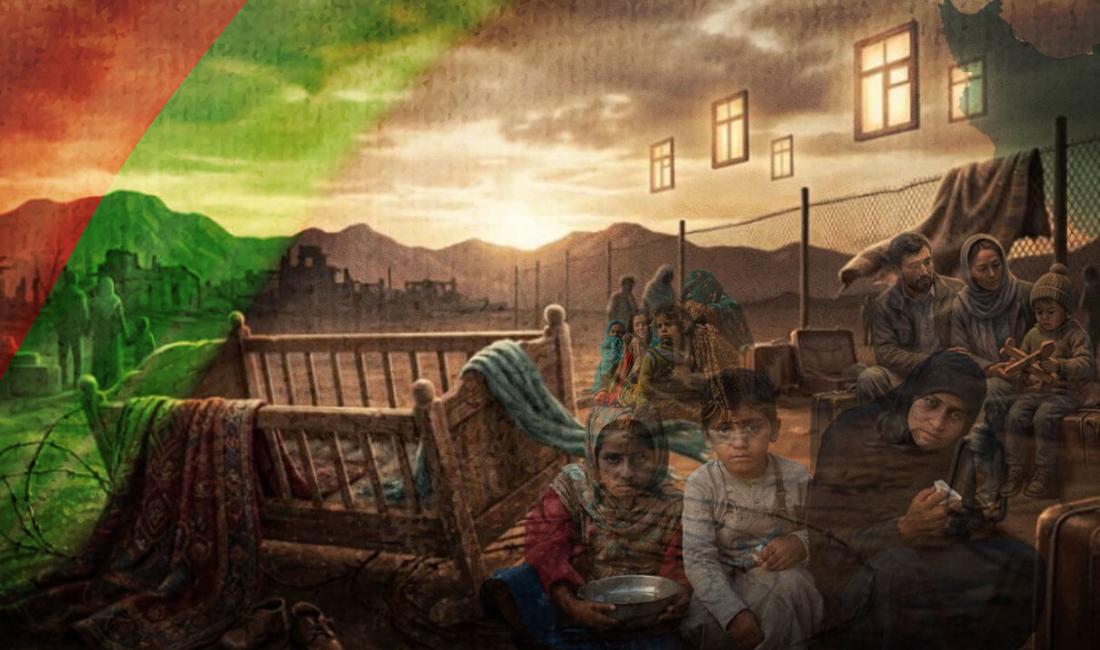
Iran Deports Afghans, Including Ethnic MInorities, to a Homeland Where They Never Felt Safe
This article was produced by Asia Democracy Chronicles in collaboration with Egab. Image by Asia Democracy Chronicles.
Within hours after an early-morning knock woke up Nader Ahmadi, the 38-year-old Afghan and his wife and four children were being forced into a crowded bus. They had been told suddenly to leave their home in Karaj, in north-central Iran; all they had managed to take with them were just whatever any clothing and bags they could get their hands on.
By the next day, the bus had reached the Islam Qala-Dogharon border crossing. Under the burning July sun, the family of six and the other passengers stepped off the bus at Herat and were greeted by the dusty winds of Afghanistan.
“I knew I was returning to my country,” recalls Nader, who is using a pseudonym for this story. “But for my 9-year-old daughter Fatima, born in Iran, everything was new.” His three older children were born in Iran as well, and, like Fatima, they had never set foot in Afghanistan before. But last year, Iran revoked temporary residence documents that had allowed its millions of Afghan migrants and refugees limited access to work and education.
Practically overnight, the likes of the Ahmadis, who had been in Iran for much of their lives, were reclassified overnight as undocumented, thereby exposing them to raids, detention, and expulsion.
According to the U.N. Refugee Agency, there were approximately 4.5 million Afghans in Iran before the deportation campaign began in January 2025, including 750,000 refugees, 586,000 passport holders, and 3.1 million undocumented individuals identified via a 2022 headcount.
The scale of the deportations spiked following Israel’s 12-day war on Iran in mid-June. Iranian officials called the deportation campaign a security measure amid reports that Israel’s Mossad was recruiting Afghan refugees for sabotage operations inside the country.
\A briefing by the independent disaster-analysis organization ACAPS revealed that more than 1.9 million Afghans in Iran returned to their home country between January and August 2025, with 1.1 million of that number forcibly deported.
By mid-December, it was estimated that deportations from Iran, along with those from Pakistan, which was running a similar campaign, had already pushed a total of 2.6 million people back into Afghanistan.
In search of a safe place
The trigger to these mass deportations from Iran was a mandate to expel “illegal foreign nationals” by March 2025. That deadline was later extended to July 2025, and The the deportation surge peaked on July 4, when 50,000 people crossed from Iran into Afghanistan in a single day at temperatures exceeding 40 degrees Celsius.
The mass deportations are still ongoing. Their erstwhile host country is also now experiencing a political and economic meltdown. Yet many Afghan returnees say that if it were not for the threat of war hanging over Iran, they would still prefer to stay there than return to their home country. This is especially true for the Hazara, a Shi’a Muslim minority in Sunni-majority Afghanistan, and whose distinct Central Asian features make them visible targets for ethnic profiling. Even Nader Ahmadi and his family stand out in a crowd of Afghan deportees.
Remarks Ali Nazar Mosavi, a Hazara legal rights activist from Afghanistan’s Ghor province: “As a Persian-speaking, Shi’a-majority nation, Iran offers a safer environment than Afghanistan, where Hazaras face targeted violence from groups like ISIS, even though they encounter the same general discrimination as other Afghan migrants.”
Iranians tend to discriminate against Afghans, and the Hazara’s features easily identify them as such. Nader says that he experienced discrimination in Iran not for being Hazara, but for being an Afghan.
These affronts ranged from not being allowed into shops, where owners posted banners stating “Afghan nationals are forbidden,” to experiencing verbal abuse and systematic exclusion of their children from schools.
But Nader and other Hazara say that they go through worse in their own country. While they make up the third largest ethnic group in Afghanistan – some 10 percent of the country’s 40 million people – the Hazara have long suffered from discrimination there, mainly because of their faith.
Nader says that during times of conflict, Hazara become a target of ethnic violence and terrorist attacks. This is why his family, like those of hundreds of other Afghan Hazara now deported from Iran, has been trapped in a cycle of fleeing and returning from and to Afghanistan.
Nader’s parents had first escaped to Iran during the Afghan Civil War, but went back to their homeland following the 2001 U.S. invasion of Afghanistan. They left for Iran again in 2006 after a conflict between the Taliban and the Afghan government backed by the United States U.S. and its Western allies.
Aside from Iran, Afghan Hazara have also fled to nearby Pakistan, and sought as well as have sought seeking asylum in some Western countries and more far-flung nations such as Australia and Indonesia.
There is no sign of that trend ending just yet. In the last several decades, the Hazara have been frequently targeted by extremist groups like the Islamic State-Khorasan Province (IS-KP/Daesh). The Taliban itself views them as “infidels” and has done little to stop the attacks. Indeed, there have been waves of mass atrocities and even state policies against the Hazara in Afghanistan, which several legal experts and rights advocates now see as amounting to genocide.
Crises big and small
Rights activist Khodadad Joya, a construction engineer by trade, says that among the Afghan deportees, the Hazara are the most at risk of undergoing hardships.
“The Taliban use administrative pretexts like residence documents to systematically exclude Hazaras from aid,” says Joya. He also points out that Hazara-majority regions remain among the least developed in the country, with scarce roads, minimal infrastructure, and thin public services. “The result is that the deportation of Hazara makes them more vulnerable to poverty, to hunger, and to violence.”
Mohammed Akbari, a Hazara community coordinator overseeing local support for deportees, has similar observations. He says, “In Daikundi and Herat provinces, the aid goes mostly to Taliban supporters or certain groups. Hazaras receive the least.”
For sure, there had been no expectations of any joyous homecoming for the Afghan returnees – Hazara or otherwise – especially since the mass deportations themselves have only complicated matters all the more for Afghanistan. After all, the country is still severed from the global financial system, its central bank assets frozen in the United States, limiting private sector development and cutting off access to multilateral institutions.
Climate shocks have compounded the crisis. Drought and floods displaced nearly 400,000 people in early 2025, according to the U.N. migration office, while depleting water sources and destroying crops across the country. In its report last December, the World Food Programme said that the country’s worsening economy had pushed over 17 million people – nearly half of Afghanistan’s population – into acute hunger as winter set in.
It did not come as a surprise that the Taliban seemed to have no energy left to map out a system to help the thousands of deportees streaming into Herat. While Taliban representatives were present at the border, their role was strictly limited to security and administration and excluded the distribution of humanitarian aid.
Akbari, who, with his small team of volunteers, helped deportees arriving in Herat early on, says flatly: “There was no real government plan.” Unfortunately, he says, the flood of Afghan deportees had also overwhelmed underfunded international aid organizations and local volunteer teams.
“The international response was limited at the border with a few pockets of baby milk and tents or phone services,” says Akbari. “Ordinary Afghans were helping each other using their own vehicles and donations to move families from camps into mosques and stadiums, and then on to other provinces.”
Afghan volunteers used their own cars, buses, and trucks to transport refugees from the border to Herat and distributed essential supplies like food and water. The volunteers also directed families to crowded mosques and stadiums, where rows of U.N. tents stretched across the playing fields.
Direct assistance for basic needs, such as providing phone calls to family members for those without Afghan SIM cards, was largely managed by the U.N. High Commissioner for Refugees (UNHCR), World Vision, and other U.N.-related organizations operating in the area.
Difficulties ten times over
With no official housing available, many deportees are often forced to rely on local communities for temporary refuge or borrow money to purchase tents, including makeshift ones provided by the United Nations. The sudden influx of people has driven up rent and housing prices across Herat, as many seek rooms to spend the night. For those who lived in Iran for decades and no longer have property in Afghanistan, the search for a stable shelter can take months.
For Hazara returnees like the Ahmadis, the difficulties are multiplied. In Herat, Taliban authorities told Nader that he and his family can receive aid only in their original place of residence. It was Akbari and his team who helped arrange the family’s relocation onward. The Ahmadis ended up in Dasht-e-Barchi, a Hazara neighborhood in West Kabul, where they now live in a cold cement room with no heating and little food.
“I spent days looking for work,” Nader says. “But I found no jobs to feed my family.” His top worry, however, is keeping his family away from harm. “We are afraid all the time to be attacked in the mosque or in our neighborhoods,” he says.
Dasht-e-Barchi has suffered repeated ISKP/Daesh attacks over the years. In 2022, at least three educational institutions there were bombed, killing more than a hundred and injuring several more young Hazara. In Herat, where the Ahmadis stepped off the bus, gunmen opened fire inside a Shi’a mosque in April 2024, killing six worshippers.
In Uruzgan province, Khas Uruzgan district residents say that since the Taliban’s 2021 return to power, there has been a rash of killings of Hazara. Just last December, a young Hazara father of two was stabbed to death in front of his home, which, the publication Kabul Now noted, was “just 200 meters from the Taliban’s district police office.” Kabul Now also quoted a relative of the victim as saying the motive “was the insistence that Hazaras should not live in Uruzgan, especially in Saidan.”
Nader says that his youngest daughter still asks when they will go back to Karaj. He himself has been thinking about how he and his family can return to Iran. “I am not just worried about the security and economic situation affecting my family,” says Nader. “I am also worried about their future, like education.”
The Taliban has banned women and girls from attending school beyond the primary level. Today more than 2.2 million Afghan girls are barred from secondary education, and up to seven million children are out of school due to the ban and other constraints, according to the United Nations.
“I know the only way to survive this situation is to return to Iran,” says Nader, “but it is also a financial hurdle.”
Iranian visas on the black market go for as much as AFN 100,000 ($1,400) each, according to returnees. Although there have been reports of arrests of those who received fraudulent documents, Nader sounds determined as he says, “My only goal now is to find a way to pay that price and get back to Iran.”